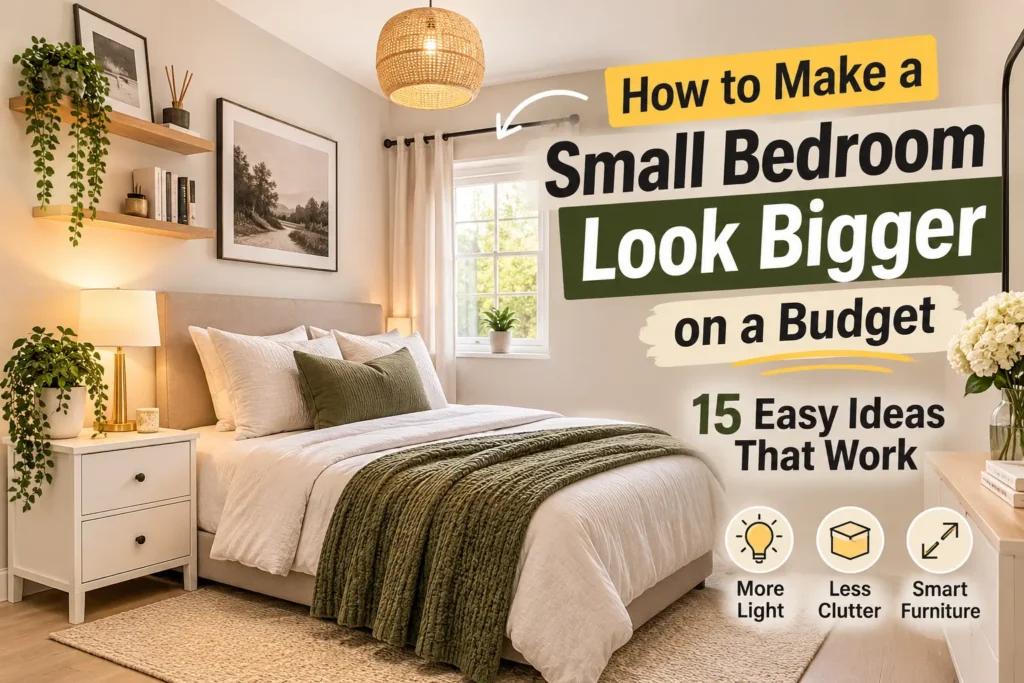
If you want to make a small bedroom look bigger, you do not need a builder, a big budget or a brand new floor plan. Most small rooms feel tight for simple reasons: too much clutter, too little light and furniture that is the wrong size or shape. Fix those three things and the room can change quickly. This guide walks you through 15 practical ideas, with real costs in dollars and pounds, so you can start this weekend.
Quick Answer: How to Make a Small Bedroom Look Bigger
To make a small bedroom look bigger, use light colours, add mirrors opposite a window, choose furniture with legs and built in storage, hang curtains high and wide, and keep the floor as clear as possible. These changes increase light, create height and reduce clutter, which makes any room feel more open without major building work.
Why Small Bedrooms Feel Even Smaller
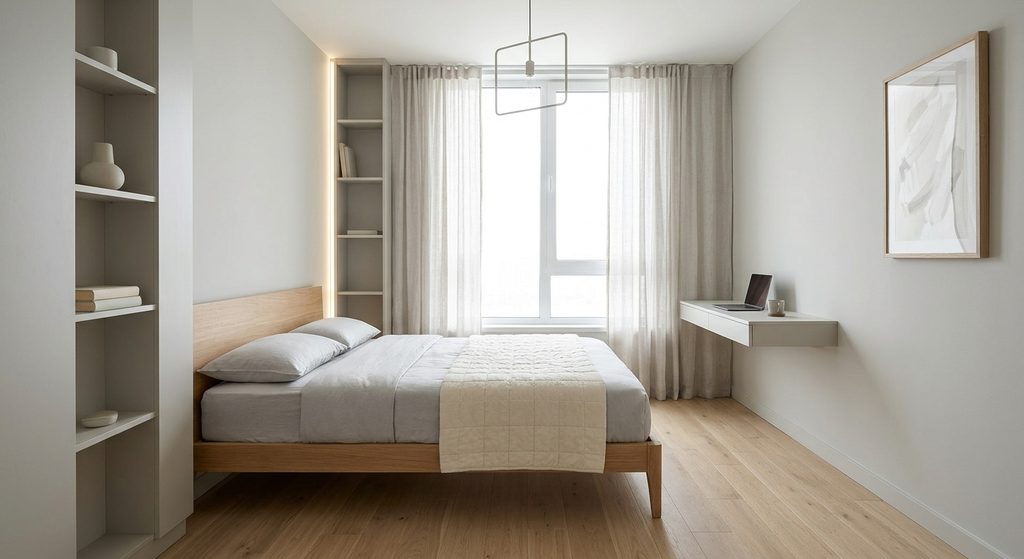
Our eyes judge space by what they can see. When a room has dark corners, heavy furniture, visible clutter and lots of different colours, the eye stops often and the brain reads the space as crowded. When the eye can travel smoothly along walls, across the floor and up to the ceiling, the room feels calmer and larger.
That is why professional designers focus on three things in small rooms: light, lines and clear surfaces. If you enjoy the thinking behind this, our Style Psychology section explores how colour, shape and space affect the way we feel at home.
How Much Space Do You Actually Have?
Before you buy anything, measure the room. Write down the length and width of the walls, the height of the ceiling, and the position of the door, window and radiator or heater. Note where the door swings. This simple sketch saves money because it stops you buying furniture that does not fit.
Idea 1: Clear the Clutter First
Decluttering costs nothing and gives the biggest result. A bedroom should hold sleep, clothes and a few personal items. Everything else can live somewhere else.
Try this quick method:
- Take everything off the floor, chair and dresser top.
- Sort items into keep, donate, bin and move to another room.
- Put back only what you use weekly.
- Give each remaining item a home, such as a basket, drawer or shelf.
A clear dresser top and empty floor make the room feel larger straight away. If you want more ideas for tidy living, browse the Home & Aesthetic category for organisation and decor guides.
Idea 2: Paint the Walls a Light, Soft Colour
Light colours reflect more light, so the walls seem to move back. Paint has a measure called light reflectance value, or LRV, on a scale from 0 for black to 100 for pure white. Many paint makers publish it on the tin or website. For small rooms, a colour with an LRV above 60 is a useful target.
Good choices include soft white, warm cream, pale grey, light sage and misty blue. A gallon or four litre tin of good paint usually costs between 25 and 50 dollars or about 20 to 40 pounds.
Paint the Ceiling Too
Painting the ceiling a bright white, or one shade lighter than the walls, makes the room feel taller. Avoid dark ceilings in a small bedroom unless you love a cosy cave look.
Try One Colour Family
Using different shades of the same colour on walls, bedding and curtains creates a smooth look. It removes visual breaks and makes the space seem to flow.
Renting and Cannot Paint?
Use light coloured bedding, curtains and rugs to get a similar effect. You can also use removable wall panels or large fabric wall hangings in pale tones.
Idea 3: Maximise Natural Light
Light is the most powerful tool in any small room. Keep the window area clear. Move tall furniture and plants away from the glass. Clean the window inside and outside, because dirty glass can block more light than you expect.
Choose sheer or light filtering curtains for the day and add a blackout liner or blind if you need darkness for sleep. Our guide to better rest from the NHS sleep pages explains why a dark, quiet and cool bedroom helps most people sleep.
Idea 4: Layer Your Artificial Light
One central ceiling light can flatten a room and leave dark corners. Layering light fixes this.
- Ambient light: the main ceiling light or a pendant
- Task light: a bedside lamp or wall mounted reading light
- Accent light: a small lamp on a dresser or LED strip behind a headboard
Choose bulbs in the warm white range of about 2700 to 3000 kelvin for a restful feel. The US Department of Energy notes that LED bulbs use much less energy than older bulbs and last far longer, so they save money over time. You can read more on the Energy Saver pages on energy.gov.
A plug in wall lamp or a clip on light costs about 15 to 30 dollars or 12 to 25 pounds and frees up bedside table space.
Idea 5: Use Mirrors the Smart Way
A mirror placed opposite or beside a window bounces daylight deeper into the room and gives the illusion of more depth. A large leaning floor mirror is one of the best low cost upgrades. Many are available for 40 to 100 dollars or 30 to 80 pounds, and secondhand shops often have them for less.
Where Not to Put a Mirror
Avoid placing a mirror where it reflects clutter or a pile of laundry. Reflecting a messy corner doubles the mess. A mirror facing a window, a pretty plant or a light wall works much better.
Mirrored Wardrobe Doors
If you already have a wardrobe, mirrored doors help a lot. If not, a long mirror on the back of the door is a cheap alternative.
Idea 6: Choose Furniture With Legs
Furniture that sits on legs lets you see the floor underneath, and the more floor you can see, the bigger the room feels. Pick a bed with slim legs, a bedside table with a shelf and open space beneath, and a dresser on tapered legs.
Avoid heavy bed frames with thick bases and bulky headboards unless they contain real storage.
Scale Matters
The furniture should suit the room. A queen or double bed in a tiny room may leave no space to walk. Sometimes a smaller bed gives you better flow. Leave at least 60 centimetres or about 24 inches of walking space around the bed on at least two sides when possible.
Idea 7: Build In Storage Without Building Anything
Storage keeps surfaces clear. Look for items that work twice.
- A bed with drawers or a lift up base
- Under bed boxes on wheels, about 15 to 30 dollars or 12 to 25 pounds
- A bench at the foot of the bed with a lid
- Floating shelves above the bed or on a blank wall
- Over the door hooks and organisers
- Stackable baskets in a wardrobe
Use Vertical Space
Walls often have more space than the floor. Tall, narrow shelves and tall wardrobes draw the eye upward and keep the floor clear. Fix tall furniture to the wall with the safety straps that come in the box, especially in homes with children.
Idea 8: Hang Curtains High and Wide
Hang the curtain rod close to the ceiling, or at least 10 to 15 centimetres (4 to 6 inches) above the window frame. Extend it past the window on each side so the curtains frame the glass rather than cover it. This creates an illusion of height and lets more light in when the curtains are open.
Choose floor length curtains in a light, plain fabric. Simple linen look or cotton curtains from major home stores often cost 20 to 50 dollars or 15 to 40 pounds per pair.
Idea 9: Pick the Right Rug
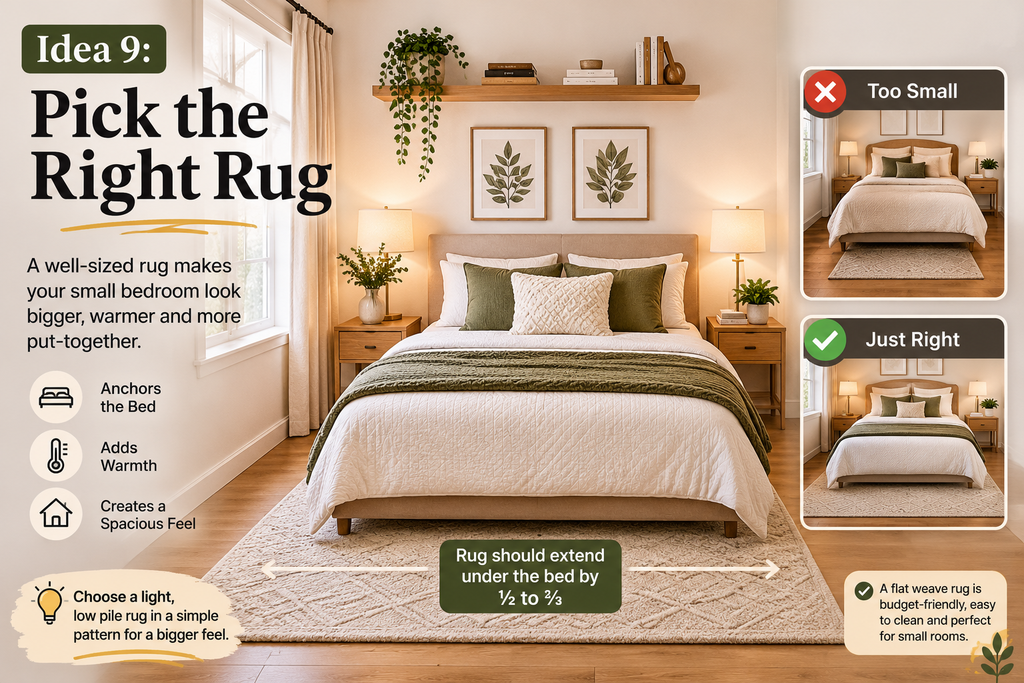
A rug that is too small can make the floor look chopped up. A rug that extends under the bed by about half to two thirds makes the bed feel anchored and adds warmth. In a small bedroom, choose a light, low pile rug in a simple pattern or plain colour.
If you have a small room and a tight budget, a flat weave rug is easy to clean and keeps the look tidy.
Idea 10: Keep Bedding Simple
Bedding is the largest piece of fabric in the room. Plain, light coloured bedding in one or two tones helps the room look calm. Add texture instead of busy patterns, using a knitted throw, a waffle blanket or linen pillow covers.
A good rule is to use no more than three colours in the room and keep one as the main shade.
The 60 30 10 Idea
Designers often use this simple rule. Use 60 percent of one main colour, 30 percent of a second and 10 percent of an accent. For example, the walls and curtains are soft white, the bedding and rug are light grey, and a few cushions are dusty blue.
Idea 11: Make Walls Work With Vertical Lines
Vertical lines lead the eye upward. Try tall artwork, a long mirror, narrow shelves or even vertical stripes in a soft shade. Avoid hanging a lot of small frames in a random way. If you love a gallery wall, keep frames in a matching colour and align them neatly.
Hang Art Slightly Higher
When art is hung with its centre at about 145 centimetres or 57 inches from the floor, it sits at eye level. Over a bed, leave about 15 to 25 centimetres or 6 to 10 inches between the headboard and the frame.
Idea 12: Hide Cables and Tech Clutter
Cables and chargers quickly make a room look messy. Use cable clips, a small box for chargers and a single power strip mounted to the wall or under a desk.
If your WiFi router lives in the bedroom, move it to a shelf or place it in a ventilated box so it is not on show. Just be careful, because hiding a router in a closed cabinet or behind thick objects can weaken the signal. Our article on household items that block WiFi signals explains what to avoid so your connection stays strong.
Idea 13: Choose Open or Light Headboards
A big dark headboard dominates a small room. Instead, try a slim upholstered headboard in a light colour, a rattan or cane style piece, or even a painted shape on the wall behind the bed. A painted headboard costs only a small sample pot of paint and a roll of tape.
Idea 14: Add Plants or Natural Touches
One or two plants add life without taking much space. Choose a plant that suits low light if your window is small. Snake plants and pothos are common easy options. A small plant on a shelf or a trailing plant on a high shelf keeps the floor clear.
Natural textures such as wood, linen and cotton make the room feel warm and calm.
Idea 15: Keep the Floor Clear and the Door Open
Finally, keep the floor mostly empty. Do not store boxes in the corners or leave bags beside the bed. Check that the door can open fully without hitting furniture. If the door hits the bed, consider swapping to a sliding door, a curtain or a door that opens outward when your home allows it. A smooth path from door to bed makes any bedroom feel larger.
Small Bedroom Layout Tips
The best layout depends on your room, but these simple guidelines help.
Put the Bed Against the Longest Wall
This leaves more floor open in the middle. In a very narrow room, you may prefer the bed on the short wall so you have room to walk along one side.
Do Not Block the Window
A low bed under a window can work, but avoid tall headboards that cover the glass.
Create One Focal Point
Choose a single feature such as the bed, a piece of art or a window view, and let everything else stay calm around it.
Budget Plan: What to Buy at Each Price Level
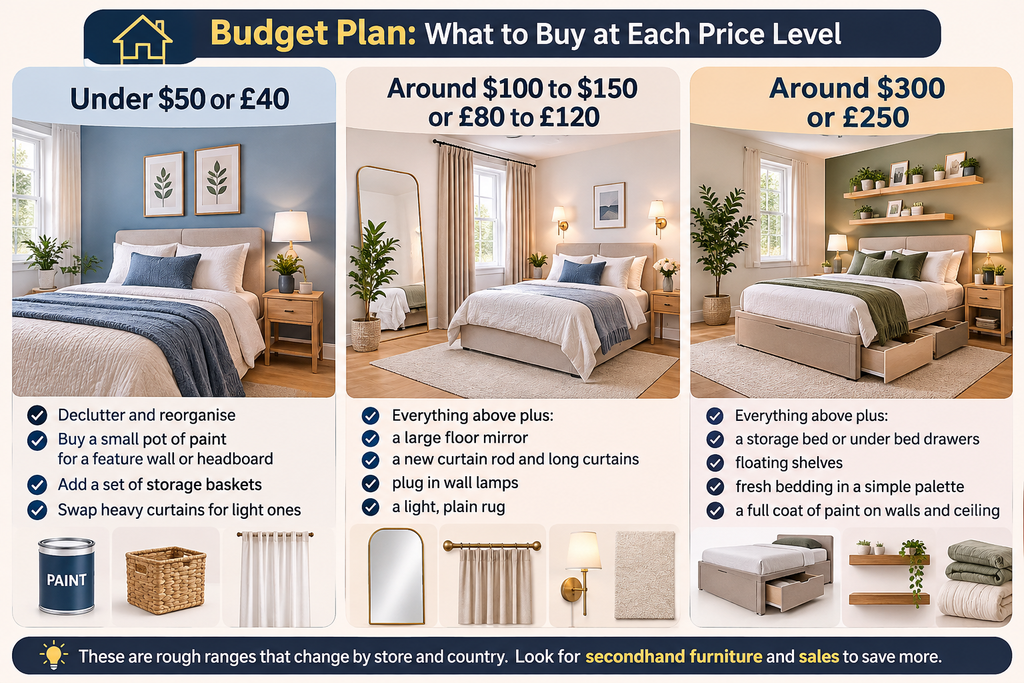
Under 50 dollars or 40 pounds:
- Declutter and reorganise
- Buy a small pot of paint for a feature wall or headboard
- Add a set of storage baskets
- Swap heavy curtains for light ones
Around 100 to 150 dollars or 80 to 120 pounds:
- Everything above plus a large floor mirror
- A new curtain rod and long curtains
- Plug in wall lamps
- A light, plain rug
Around 300 dollars or 250 pounds:
- Everything above plus a storage bed or under bed drawers
- Floating shelves
- Fresh bedding in a simple palette
- A full coat of paint on walls and ceiling
These are rough ranges that change by store and country. Look for secondhand furniture and sales to save more.
Common Mistakes to Avoid
- Buying furniture before measuring the room
- Using many bold colours and patterns in one small space
- Hanging curtains right at the top of the window frame
- Pushing every piece of furniture against the wall without leaving walking space
- Keeping too many decorative items on surfaces
- Using one harsh ceiling light as the only source of light
A Simple One Weekend Plan
- Saturday morning: measure, declutter and clean the room.
- Saturday afternoon: paint walls or ceiling, or prepare small touches if you rent.
- Sunday morning: change curtains, move furniture and place the mirror.
- Sunday afternoon: add lamps, tidy cables and style shelves with only a few items.
By Sunday evening the room should feel brighter, calmer and more open.
Frequently Asked Questions
What colour makes a small bedroom look bigger?
Light colours such as soft white, cream, pale grey, light sage and misty blue make a small bedroom look bigger because they reflect more light. Using the same colour family on walls, curtains and bedding also helps the room feel smooth and open.
Do mirrors really make a room look bigger?
Yes. A mirror placed opposite or beside a window reflects daylight and creates a sense of depth. Place it where it reflects something pleasant, such as a window or plant, and not a messy corner.
Where should the bed go in a small bedroom?
Place the bed on the longest wall when possible, so the middle of the room stays open. Keep at least 60 centimetres or 24 inches of walking space on two sides, and avoid blocking the door or window.
How can I add storage to a small bedroom cheaply?
Use under bed boxes, over the door hooks, a lidded bench, floating shelves and stackable baskets. Choose pieces that serve two purposes, such as a bedside table with drawers or a bed with built in storage.
Is it better to paint a small bedroom dark or light?
Light colours usually make a small room feel larger. A dark colour can look stylish and cosy, but it makes the walls feel closer. If you love dark shades, use them on one wall or in a room with plenty of natural light.
Final Thoughts
You can make a small bedroom look bigger with simple choices. Start with clearing clutter, then focus on light colours, good lighting, mirrors, smart storage and furniture that suits the room. You do not have to do everything at once. Pick three ideas from this list, try them this weekend and see how the room feels.