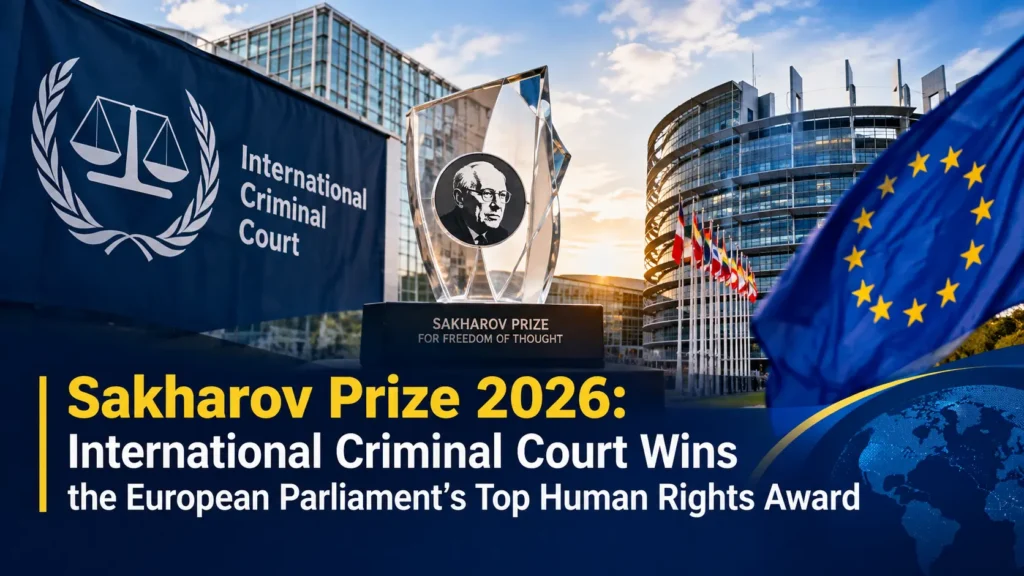
The International Criminal Court (ICC) has won the Sakharov Prize 2026, one of the European Union’s most important human rights awards. European Parliament President Roberta Metsola announced the result on Thursday, October 22, 2026, in Strasbourg, France. The news was widely reported by Reuters and other outlets and is one of the top stories in Europe on Friday, October 23.
This article explains the announcement in plain language. You will learn what the Sakharov Prize is, how winners are chosen, what the ICC does, why the timing has drawn attention, how different people have reacted and what happens next. It is written for readers in the USA, UK, Australia and Europe, and it is based on reports from Reuters, Euronews, EU Neighbours East, NL Times, the Brussels Signal and other sources checked on October 23, 2026.
The Short Answer: Who Won the Sakharov Prize 2026?
The Sakharov Prize 2026 was awarded to the International Criminal Court and its officials, European Parliament President Roberta Metsola announced in Strasbourg on October 22, 2026. The human rights prize comes with 50,000 euros. The formal ceremony is planned for December 16, according to EU Neighbours East, and the other finalists were Tundu Lissu and Taraneh and Romina Rahimi.
The rest of this article gives the background and the different views on the story.
What Happened on October 22
According to Reuters, Metsola announced the winner in the Strasbourg chamber to a standing ovation. NL Times reported that lawmakers from several political groups, including the centre right European People’s Party, the Socialists and Democrats, Renew Europe and the Greens, stood to applaud. Metsola said the EU is built on respect for multilateralism and international institutions, and that the prize recognises the court’s work in upholding international law and justice.
The ICC’s president, Judge Tomoko Akane, responded by saying that the unprecedented challenges facing the court make the award even more significant. She also said the prize underlines the importance of continued international cooperation so the court can carry out its mandate independently and impartially, according to Reuters.
The announcement came after a shortlist was published earlier in the week. Several outlets, including Euronews, led their bulletins with the result on October 23.
What Is the Sakharov Prize?
The Sakharov Prize for Freedom of Thought is a human rights award given each year by the European Parliament. It was established in 1988 and is named after Andrei Sakharov, the Soviet physicist and dissident who campaigned for human rights. It honours individuals and organisations that defend human rights and fundamental freedoms.
Past winners include Russian opposition figure Alexei Navalny in 2021, the people of Ukraine in 2022, and Jina Mahsa Amini and the Woman, Life, Freedom movement in Iran in 2023. In 2025, the prize went to journalists Andrzej Poczobut and Mzia Amaglobeli. The winner receives 50,000 euros, according to NL Times.
How is the winner chosen?
The process has several steps. Political groups and individual members of the European Parliament put forward candidates. The Parliament’s Committee on Foreign Affairs and Committee on Development, together with the Subcommittee on Human Rights, then agree a shortlist. The final choice is made by the Conference of Presidents, which is made up of the Parliament’s President and the leaders of the political groups. The winner is then presented at a ceremony in Strasbourg in December.
Who was nominated in 2026?
Six nominations were presented this year, according to the European Parliament news reports: Hussam Abu Safiya, Nayib Bukele, the International Criminal Court and its officials, Tundu Lissu, the sisters Taraneh and Romina Rahimi, and the organisation Standing Together. A nomination reflects the view of the political group that proposes it and not an endorsement by the whole Parliament. Three finalists reached the final stage: the ICC, Tundu Lissu and the Rahimi sisters.
What Is the International Criminal Court?
The ICC is a permanent international court based in The Hague in the Netherlands. It was set up in 2002, according to EU Neighbours East, and it investigates and prosecutes individuals accused of genocide, crimes against humanity, war crimes and the crime of aggression.
Two points help explain how the court works.
- It tries individuals, not countries. The ICC can bring cases against people accused of the most serious crimes, but it does not judge governments as a whole. A different body, the International Court of Justice, settles disputes between states.
- It depends on its member countries. The court was created by a treaty known as the Rome Statute, and it has no police force of its own. It relies on member countries to carry out arrest warrants and cooperate with investigations.
The United States and Israel are not parties to the Rome Statute, and both have disputed the court’s authority over their nationals. Many European countries, along with several in Africa, Asia and Latin America, are members. For wider coverage of international events, visit our World News section.
Why the Timing Has Drawn Attention
The prize arrives at a sensitive moment for the court. Reuters reported that it came less than two weeks after US President Donald Trump announced sanctions against the ICC, and less than two weeks after former ICC judge Navi Pillay received the Nobel Peace Prize. Reuters described the Nobel decision as widely seen as a show of support for the court.
Reuters also reported that the ICC has long been a target of Mr Trump, and that his campaign against it has grown since the court issued arrest warrants in 2024 for Israeli Prime Minister Benjamin Netanyahu and his former defence minister. The United States has previously imposed sanctions on individual court officials. Sanctions of this kind are financial and travel restrictions that can make it hard for the people affected to use banks, hold accounts or travel to certain countries.
In short, two major awards in one month, both going to the court or a former judge, have been interpreted by many observers as a signal of support from European and international institutions at a time of political pressure.
Reactions: Supporters and Critics
As with many stories about international law, reactions differ, and it is important to hear more than one side.
Supporters
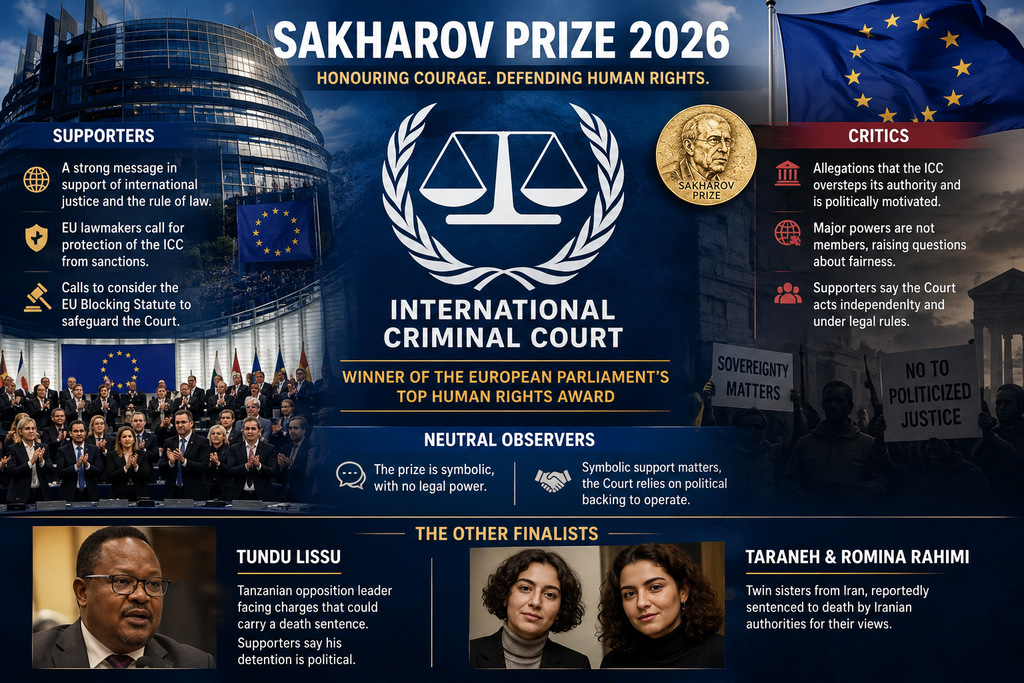
European lawmakers who backed the prize said it shows commitment to international justice. The Socialists and Democrats group, which nominated the court, argued that supporting the ICC means supporting international law. NL Times reported that Dutch MEP Reinier van Lanschot of Volt called the court a more than deserving winner, while MEP Catarina Vieira called on the EU to go beyond the prize and take all possible steps to protect the court from sanctions. Several MEPs have also asked the EU to consider a legal tool known as the Blocking Statute, which is designed to limit the effects of some foreign sanctions inside the EU. Whether it will be used is not yet decided.
Critics
Critics of the court, including the current US administration, argue that it oversteps its authority and that some of its decisions are politically motivated. They also point out that major powers are not members. Supporters of the court reject this and say its judges and prosecutors act independently and under legal rules. These are contested views, and readers who want to understand them should read the arguments of both sides directly from official statements and trusted news reports.
Neutral observers
Some analysts say the prize is largely symbolic, because it comes with money and attention but no legal power. Others say symbolic support matters because the court depends on political backing from its member countries to function. Both points can be true at the same time.
The Other Finalists
The ICC was not the only finalist, and the other two stories are important in their own right.
- Tundu Lissu: A Tanzanian opposition leader. According to EUobserver, he is in court facing charges related to inciting the public to disrupt an election, and he faces the possibility of a death sentence. His supporters in the European Parliament, including David McAllister of the European People’s Party who co nominated him, say his detention is political. The Tanzanian authorities have brought the case through the courts.
- Taraneh and Romina Rahimi: Twin sisters from Iran who were prosecuted by Iranian authorities and, according to reports, have been sentenced to death. They were put forward as symbols of people prosecuted for their views in Iran.
Because the Sakharov Prize focuses on freedom of thought, the shortlist often includes people and groups facing legal action or imprisonment in several different parts of the world.
What Happens Next
The ICC and its officials will receive the prize at an official ceremony in Strasbourg on December 16, according to EU Neighbours East. Here are the main things to watch in the coming weeks.
- The ceremony. The date is set for December, when a representative of the court is expected to accept the award in the European Parliament.
- The EU response to sanctions. MEPs are calling for stronger action to protect court officials, and the European Commission and member states will decide how to respond.
- US and EU relations. The prize and the sanctions may add to wider discussions between Washington and Brussels about international institutions.
- The court’s ongoing cases. The ICC continues to handle investigations and trials, and any new decisions will draw attention.
We will keep following the story in our Latest News section.
Why This Story Matters to Everyday Readers
It might seem like a distant political story, but international courts, sanctions and human rights prizes can affect ordinary people in several ways.
First, sanctions can affect banks, businesses and travel. Companies that work internationally sometimes have to adjust their rules to avoid breaking sanctions laws, and our Business section covers how global events can reach the economy. Second, international law shapes how countries are expected to behave in conflicts, which affects civilians in war zones. Third, the story is part of a bigger conversation about how much power international institutions should have and who should hold them to account. People hold different views on that question, and that debate is likely to continue.
Other Headlines in Europe Today
The Sakharov Prize was one of several stories in Euronews’ morning bulletin on October 23, 2026. Others included:
- French unions said they were disappointed after a meeting and called for a day of action on November 5.
- Truckers’ protests over fuel prices in Italy led to empty supermarket shelves in parts of the south.
- In Ukraine, at least nine people were reported killed in Russian attacks over the previous 24 hours.
- The art world gathered in Paris for Art Basel despite unrest in France.
These stories are developing, so check trusted news sources for the latest information.
How to Follow International News Responsibly
Stories involving courts, sanctions and politics often spread quickly on social media. A few simple habits can help you stay well informed.
- Read the original report from a major news agency such as Reuters, the Associated Press or the BBC.
- Compare how at least two different outlets describe the same event.
- Separate facts, such as what was announced and when, from opinions about what it means.
- Check the date, because older stories are often shared as if they are new.
- Be careful with images and clips that appear without a source.
For more background, you can read the Reuters report on the Sakharov Prize announcement and the NL Times report on reactions in the European Parliament. You can also visit the official ICC website to learn how the court describes its own work.
Frequently Asked Questions About the Sakharov Prize 2026
Who won the Sakharov Prize 2026?
The International Criminal Court and its officials won the Sakharov Prize for Freedom of Thought 2026. European Parliament President Roberta Metsola announced the result in Strasbourg on October 22, 2026.
How much is the Sakharov Prize worth?
The prize comes with 50,000 euros, according to NL Times. The winner also receives wide international attention, which many supporters consider as valuable as the money.
When is the Sakharov Prize ceremony?
The official ceremony is planned for December 16, 2026, in the European Parliament in Strasbourg, according to EU Neighbours East.
Who else was shortlisted for the Sakharov Prize 2026?
The other finalists were Tanzanian opposition leader Tundu Lissu and the Iranian sisters Taraneh and Romina Rahimi. Six candidates were nominated in total, including Nayib Bukele, Hussam Abu Safiya and the organisation Standing Together.
Why is the ICC in the news?
The court has drawn attention because of arrest warrants it issued in 2024, because of US sanctions announced less than two weeks before the prize, and because former ICC judge Navi Pillay recently won the Nobel Peace Prize. Reactions to these developments differ between governments, lawmakers and legal experts.
Final Thoughts
The Sakharov Prize 2026 is a clear statement of support from the European Parliament for the International Criminal Court, announced at a time of political pressure on the institution. Supporters see it as a defence of international law, while critics question the court’s authority and approach. Either way, the story will continue to develop as the ceremony in December approaches and as governments decide how to respond to sanctions. We will continue to report on developments as they happen.