Millions of Israelis are heading to polling stations today, October 27, 2026, in a national election that many people inside and outside the country see as a turning point. It is the first nationwide vote since the attacks of October 7, 2023, and the race is tight. This guide explains the Israel election 2026 in plain language. It covers who is running, what the polls say, how the voting system works and what could happen after the votes are counted.
Quick Answer: What Is Happening in the Israel Election 2026?
Israelis vote today, October 27, 2026, in the first national election since the October 7, 2023 attacks. Polls show Gadi Eisenkot’s Yashar party slightly ahead of Benjamin Netanyahu’s Likud, but neither bloc is certain to reach 61 of 120 seats, so final results and coalition talks could take weeks.
The Key Facts at a Glance
These details come from reports published on October 26 and 27, 2026 by NBC News, NPR, The Jerusalem Post and others.
- Voting takes place today, Tuesday, October 27, 2026.
- Polls open at 7 a.m. at more than 12,000 polling stations, mostly in schools, hospitals and other public buildings, according to NBC News.
- The vote will elect the 26th Knesset, Israel’s parliament, which has 120 seats.
- A party or bloc needs 61 seats to hold a majority.
- The main contest is between Prime Minister Benjamin Netanyahu’s Likud party and former military chief Gadi Eisenkot’s Yashar party.
- NPR reports that no party or bloc appears assured of a parliamentary majority and that it may take weeks or even months before it is clear who will form the next government.
Why This Election Matters
Elections in Israel always draw attention, but this one has extra weight. It comes after three years of war and crisis in the region, and it is the first time voters across the country can give their verdict at the ballot box since the 2023 attacks. NBC News described the vote as one of the biggest electoral tests of Netanyahu’s decades long political career. NPR noted that many Israelis call it the most consequential vote in the country’s history.
The result will shape Israel’s government, its security policy, its economy and its relations with other countries, including the United States and neighbours in the Middle East. That is why leaders, investors and news teams around the world are watching closely. For more on events around the globe, visit our World News section.
Who Are the Main Figures?
Benjamin Netanyahu and Likud
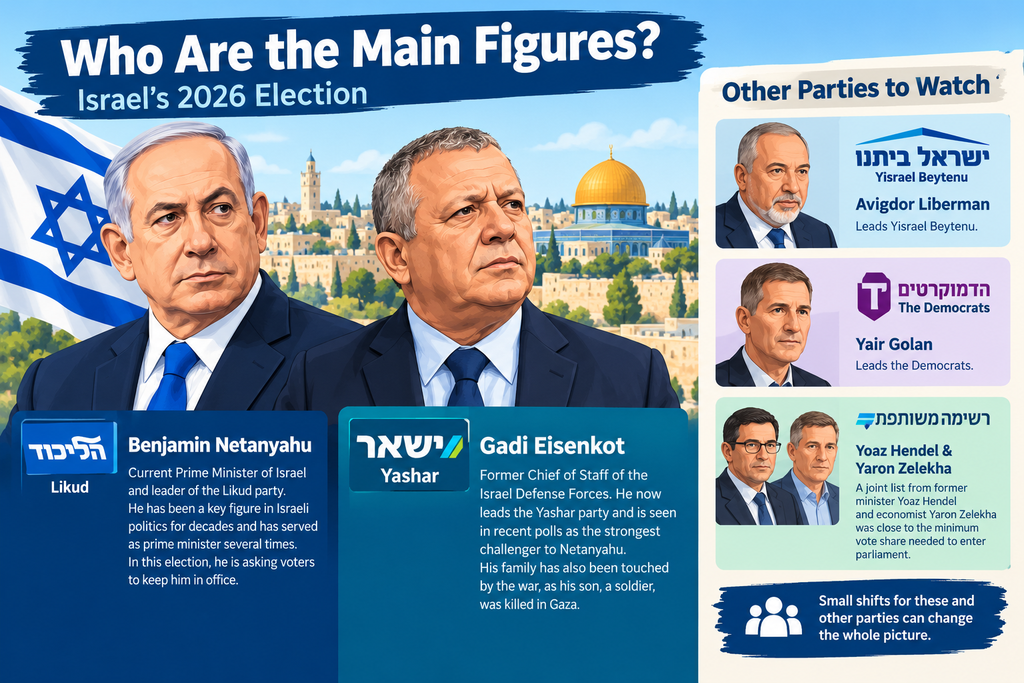
Benjamin Netanyahu is the current Prime Minister of Israel and the leader of the Likud party. He has been one of the most prominent figures in Israeli politics for decades and has served as prime minister several times. In this election he is asking voters to keep him in office.
Gadi Eisenkot and Yashar
Gadi Eisenkot is a former Chief of Staff of the Israel Defense Forces. He now leads the Yashar party and is seen in recent polls as the strongest challenger to Netanyahu. Reports from NPR note that his family has also been touched by the war, as his son, a soldier, was killed in Gaza.
Other Parties to Watch
Several smaller parties could decide who can form a majority. Polls have included Avigdor Liberman’s Yisrael Beytenu and the Democrats led by Yair Golan. The Jerusalem Post also reported that a joint list from former minister Yoaz Hendel and economist Yaron Zelekha was close to the minimum vote share needed to enter parliament. Small shifts for parties like these can change the whole picture.
What Do the Polls Say?
Polls in the final days showed a close race. It is important to read them carefully, because they are estimates and not results.
- NBC News reported that the latest Wala News poll gave Yashar 23 seats and Likud 19.
- The Jerusalem Post reported an average of four polls from Channel 12, Channel 13, Channel 14 and Maariv, showing Yashar ahead by just over two seats.
- In one Channel 13 poll, Netanyahu’s bloc was projected at 50 seats and the opposition bloc at 54, which means neither reaches 61.
- A report published before the final Friday polls said that television polls from Kan, Channel 12 and Channel 13 gave the Eisenkot bloc a lead of two to six seats over the Netanyahu bloc.
In simple terms, most polls put the challenger slightly ahead, but not by enough to guarantee a government. Polls can also be wrong. In past Israeli elections, final results have differed from polls because of late shifts, turnout and small parties that were close to the threshold.
Why Seats Matter More Than Votes
In Israel, voters choose a party list, not a single candidate. The number of seats each party wins is based on its share of the national vote. That is why the polls focus on seats and blocs, not only on which leader looks more popular.
Which Issues Are Shaping the Vote?
NBC News reported that the campaign has covered a wide range of topics, from national security and military service to everyday issues such as the economy and living costs. Here is a simple look at the main themes.
Security and the Aftermath of the War
Security is at the centre of the debate. Voters are weighing questions about how the country handled the war, how it should respond to regional threats and how it can keep people safe. Tensions in the wider region, including questions about Iran, are part of the background to the vote.
Military Service and Conscription
The rules for military service, including how they apply to different groups in society, have been a major topic in the campaign. This issue has strained relationships among parties for some time.
The Economy and Cost of Living
Like voters in many countries, Israelis are also thinking about prices, housing, jobs and public services. Economic issues often decide how undecided voters choose.
The Palestinian Question
NPR noted that neither of the two leading candidates currently supports the creation of a Palestinian state in the foreseeable future. Smaller parties hold a range of different views on this subject.
How Does Israel’s Voting System Work?
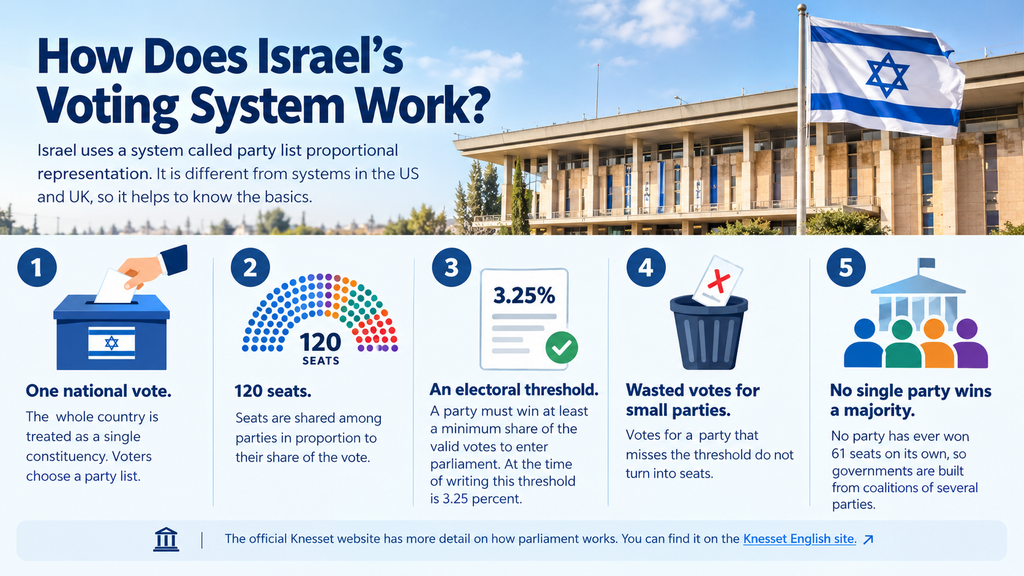
Israel uses a system called party list proportional representation. It is different from systems in the US and UK, so it helps to know the basics.
- One national vote. The whole country is treated as a single constituency. Voters choose a party list.
- 120 seats. Seats are shared among parties in proportion to their share of the vote.
- An electoral threshold. A party must win at least a minimum share of the valid votes to enter parliament. At the time of writing this threshold is 3.25 percent.
- Wasted votes for small parties. Votes for a party that misses the threshold do not turn into seats.
- No single party wins a majority. No party has ever won 61 seats on its own, so governments are built from coalitions of several parties.
The official Knesset website has more detail on how parliament works. You can find it on the Knesset English site.
What to Expect Today and Tonight
Voting runs through the day. Polling stations usually close in the evening, and the main television channels then publish exit polls, which are estimates based on interviews with voters leaving polling stations.
Exit Polls Are Not Results
Exit polls can give an early idea of the outcome, but they have been wrong in past Israeli elections. Official counting takes longer, and the totals can move as ballots from different groups of voters are counted. Treat early numbers as a guide only.
When Will We Know the Final Result?
Preliminary results usually come within a day or so, and final certified results take longer. But the real deadline is not the count. It is the formation of a government, which is a separate process.
What Happens After the Votes Are Counted?
This is the part that surprises many readers. Winning the most seats does not automatically make a leader prime minister.
Step 1: Official Results
Israel’s Central Elections Committee certifies the final results and announces which parties passed the threshold and how many seats each one won.
Step 2: The President Consults the Parties
The President of Israel meets representatives of every party in the new Knesset. Each party tells the President whom it recommends as prime minister.
Step 3: A Candidate Is Asked to Form a Government
The President usually chooses the member of parliament who has the best chance of building a majority, which is not always the leader of the biggest party. That person has 28 days to form a coalition, and the President can extend this by up to 14 days.
Step 4: Coalition Talks
The candidate negotiates with other parties about policies, government posts and budgets. These talks can be long and complicated, especially when the blocs are close in size.
Step 5: A Vote of Confidence
If the candidate reaches 61 seats, the new government is presented to the Knesset and sworn in after a vote of confidence.
What If No One Can Form a Government?
The President can give the task to another member of parliament. If no one succeeds, parliament can be dissolved and the country can head back to the polls. Israel has been through repeated elections in recent years for this very reason, so analysts are cautious about calling the final outcome too early.
What Are the Possible Outcomes?
NPR described several possible scenarios, and it is useful to think of them in simple terms.
- One bloc reaches 61. This would be the clearest path to a new government.
- Neither bloc reaches 61. Parties would have to bargain with smaller groups, and some parties might change sides or look for a broader arrangement.
- A long stalemate. If talks fail, there is the risk of another election.
Because polls suggest a very close race, the second and third scenarios are real possibilities. That is why many reports say it may take weeks or even months to see a final result.
Why the Election Matters Beyond Israel
The vote is not only an Israeli story. Several global topics are linked to it.
Regional Security
The government that emerges will make decisions about relations with neighbours and about conflicts in the region. News coverage on October 27 has also pointed to tension involving Iran, which adds to the sense of risk around the vote.
Energy and Markets
Middle East developments can influence oil prices, and oil affects inflation, transport costs and interest rates around the world. Our Business section covers how global events affect money and markets.
Diplomacy
The United States and European countries, along with other partners, will be watching who leads the next Israeli government, because it can shape talks, aid and agreements.
How to Follow the Results Responsibly
Big elections attract rumours and fake claims, especially on social media. Here are simple tips for staying informed.
- Use reliable sources such as established news agencies, public broadcasters and official election bodies.
- Remember that exit polls and early counts are not final results.
- Be careful with screenshots, edited videos and posts that claim to show results before they are announced.
- Check whether a claim appears on more than one trusted source.
- Wait for official confirmation before sharing numbers.
For continuing coverage of the day’s top stories, you can follow our Latest News section.
Quick Glossary
- Knesset: Israel’s parliament, with 120 members.
- Bloc: A group of parties that usually support the same candidate for prime minister.
- Coalition: A group of parties that agree to govern together.
- Electoral threshold: The minimum vote share a party needs to win seats.
- Exit poll: A survey of voters taken as they leave the polling station.
- Vote of confidence: The parliament vote that approves a new government.
How We Report and Check Facts
This article was written by The Urban Magazine in our own words using reports published on October 26 and 27, 2026 by NBC News, NPR, The Jerusalem Post, Axios and other news outlets, together with general background on Israel’s electoral system. You can read NPR’s own guide to the election on the NPR website. Events can change quickly, so figures and details reflect the time of publication. If you notice a mistake, please contact us through our Contact page.
Frequently Asked Questions
When is the Israel election in 2026?
The election takes place today, Tuesday, October 27, 2026. Polling stations open at 7 a.m. and close in the evening, after which television channels publish exit polls and official counting begins.
Who are the main candidates in the Israel election?
The two main contenders are Prime Minister Benjamin Netanyahu, who leads the Likud party, and Gadi Eisenkot, a former military chief who leads the Yashar party. Several smaller parties could also play a key role in forming a government.
How many seats are needed to form a government in Israel?
A governing majority needs 61 of the 120 seats in the Knesset. No single party has ever won that many on its own, so governments are formed through coalitions of several parties.
When will the final results be known?
Exit polls arrive on election night and preliminary results usually follow within a day or so. But forming a government can take weeks or even months, and the final outcome may not be clear for some time.
What do the polls say about the Israel election 2026?
Most recent polls show Eisenkot’s Yashar party slightly ahead of Netanyahu’s Likud. However, neither the Netanyahu bloc nor the opposition bloc is projected to reach 61 seats, so the outcome remains uncertain.
Final Thoughts
The Israel election 2026 is close, important and complex. The first results will arrive tonight, but the real decision about who leads the next government may take much longer. The best approach is to follow reliable sources, treat early numbers carefully and wait for official confirmation. We will continue to cover the story as it develops.