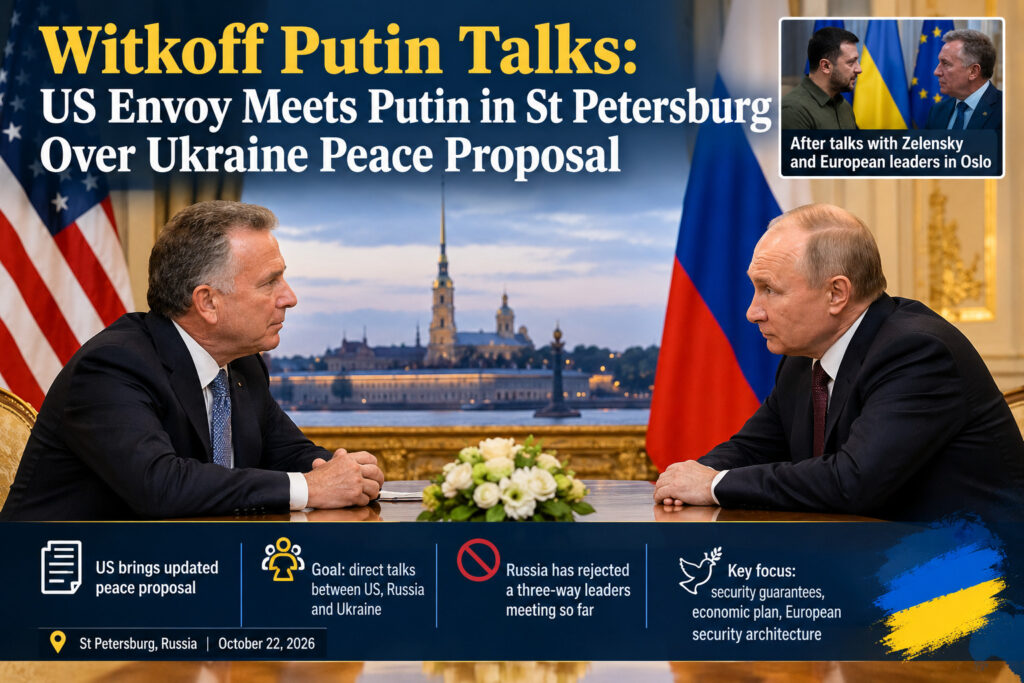
US special envoy Steve Witkoff arrived in St Petersburg on Wednesday, October 22, 2026, for talks with Russian President Vladimir Putin, carrying an updated proposal to end the war in Ukraine. The Witkoff Putin talks are the top international story of the day, because they come straight after a round of meetings in Oslo with Ukrainian President Volodymyr Zelensky and European leaders. This article explains what is known so far, what each side wants and what to watch next. At the time of writing, the outcome of the meeting was not yet known.
Quick answer: On October 22, 2026, US envoy Steve Witkoff met, or was due to meet, Vladimir Putin in St Petersburg to present an updated peace proposal drawn up with Ukraine and European partners. Washington hopes it opens the way to direct talks between the US, Russia and Ukraine. Russia has so far rejected a three way leaders meeting.
Witkoff Putin Talks: What Happened on October 22, 2026
According to reports from Moscow Times and Meduza, Witkoff landed at Pulkovo Airport in St Petersburg on Wednesday morning. He was greeted by Kirill Dmitriev, Putin’s special representative for foreign investment and a key figure in contacts with Washington. The German news agency dpa, in a report carried by Yahoo News, said the meeting was expected at the Konstantinovsky Palace near St Petersburg.
Meduza reported, citing Russian news agency Interfax, that Kremlin aide Yuri Ushakov said the two men would meet in the first half of the day and that a peace settlement would be the main topic. Ushakov also said he could not say whether any agreement would come that day. Reports from Axios and Politico said Jared Kushner, an adviser to President Donald Trump, might join the meeting remotely, and Dmitriev was expected to attend on the Russian side.
Because the talks were taking place as this article was prepared, no official readout from either government was available. Readers should check trusted news sources later in the day for updates. You can follow other major developments in our World News section.
The Run Up: Why Oslo Mattered
The St Petersburg meeting did not come out of nowhere. It followed a full day of discussions in the Norwegian capital on Tuesday, October 20.
Who was in the room
Axios reported that Witkoff met Zelensky in Oslo alongside the leaders of Norway and Finland, as well as representatives from France, the United Kingdom, Germany, Poland, the European Union and NATO. The wide guest list reflects how much Europe wants to be part of any settlement, because the outcome affects its security directly.
Norwegian Prime Minister Jonas Gahr Store said afterwards, as reported by Meduza, that Witkoff would discuss with Putin proposals worked on by European and American colleagues, and that these could possibly pave the way for a meeting at leaders’ level.
What was discussed
A US official told Axios that the Oslo discussions focused on developing a unified framework agreement to end the war. The same official said Ukraine brought forward new ideas and proposals that were discussed in detail. Reuters, as cited by Moscow Times and other outlets, reported that the talks covered several key elements of a comprehensive peace framework:
- Security guarantees for Ukraine
- A postwar economic plan
- A broader European security architecture
The US official described meaningful progress toward a coordinated approach to engaging Russia. US Secretary of State Marco Rubio, speaking during a visit to India, called the talks with Zelensky positive, according to France 24.
What Washington Is Hoping For
The United States is trying to move from separate conversations to a shared negotiating table. Axios quoted a US official saying the hope is that the updated proposal will create a pathway toward direct trilateral and broader multilateral negotiations.
Put simply, Washington wants Russia, Ukraine and the United States to sit down together, and eventually to bring in European governments and other parties too. Politico, as cited by Meduza, reported that Witkoff would offer Putin direct talks with Trump and Zelensky.
This matters because so far many of the contacts have taken place in separate formats. A US envoy meets Russian leaders, then meets Ukrainian leaders, then returns to Moscow or another capital. A trilateral meeting would be a significant step beyond that pattern, though it would not by itself guarantee an agreement.
Axios also reported that Kushner repeated Trump’s demand during the Oslo discussions that Ukraine stop attacking Russian oil refineries. This is one of several issues where Washington is pressing Kyiv as well as Moscow.
Ukraine’s Position
Ukraine has been defending itself against Russia’s full scale invasion for more than four and a half years, with Western support, according to the dpa report. Zelensky has said that the next step should be a three way meeting between himself, Putin and Trump, a format Russia has so far refused, according to Axios.
France 24 reported that Zelensky thanked Washington on Tuesday for the resumption of US intelligence on Russian strikes. That detail shows how closely Ukraine’s military position and the diplomacy are linked. Supporters of Kyiv say that security guarantees must be firm and clear before any ceasefire, so that a pause in fighting does not simply give Russia time to regroup. Ukrainian officials have also said they want to be part of any decision that affects their territory and their future.
At the same time, France 24 noted that President Trump said he was ready to meet Putin and Chinese leader Xi Jinping in China next month to discuss denuclearisation, and that talks there could also cover the Ukraine war. This prompted concern in Kyiv that Ukraine might be sidelined from decisions about its own future.
Russia’s Position and the Kremlin’s Stance
Russia has so far rejected the idea of a three way leaders meeting that includes Zelensky, according to Axios. Moscow has also pushed back on some of the proposals discussed in recent weeks. Il Sole 24 Ore, in its live coverage, headlined a Kremlin comment that Russia remains opposed to an energy truce and wants a full peace settlement instead.
Kremlin officials have said that Witkoff would be briefed on how Moscow views the talks with Ukraine and Europe, as reported by Moscow Times. Russian state media, including RT, described the visit as coming after a diesel deal between Moscow and Washington.
The Kremlin’s public line has generally been that it is open to talks but that any deal must address what it describes as the root causes of the conflict. Ukraine and most European governments reject that framing and describe the war as an unprovoked invasion. Readers should keep in mind that statements from all sides are made to support their own positions.
Europe’s Role
European leaders were in the room in Oslo for a reason. Any lasting settlement would involve European security arrangements, sanctions, reconstruction money and possibly peacekeeping or monitoring. Several European governments have also said they want a seat at the table rather than being told the results afterwards.
The Oslo talks reportedly included work on a broader European security architecture. That phrase covers a wide range of ideas, from military cooperation and air defence to arms control and rules for deployments near borders. Europe is also dealing with its own pressures, including economic strain and security concerns at home. If you want to see how these wider issues affect business and energy, visit our Business category.
The Diesel Sanctions Debate
One of the most debated parts of the story is the question of Russian diesel. Axios reported that Trump agreed to lift sanctions on Russian diesel sales and took other steps welcomed by Moscow, and that the White House hopes this will make Putin more willing to compromise.
The argument for easing
Supporters of the approach argue that diplomacy often needs incentives. Easing some restrictions, they say, could build trust, draw Russia into serious talks and reduce global fuel costs for consumers. They also point out that a negotiated settlement may require compromise from every party.
The argument against
Critics, including some of Ukraine’s supporters, question whether easing economic pressure on Russia will lead to concessions from the Kremlin. Axios noted that the arrangement has drawn criticism on exactly this point. They argue that sanctions are one of the main tools that encourage Moscow to negotiate, and that relaxing them without clear commitments could weaken the West’s hand.
Both views are held sincerely, and the real effect will depend on what Russia does next. For readers who follow energy markets, the NordFX Market Pulse on October 22 showed Brent crude trading near $110 a barrel, so fuel prices remain a major concern for households and governments.
Other Issues on the Table
Beyond the big framework questions, reports mention several other topics linked to the visit.
A detained American
Moscow Times, citing a New York Times report, said Witkoff planned to raise the release of Stephen Hubbard, an American who is accused of fighting as a mercenary for Ukraine and is held in a Russian prison. Prisoner issues often move in parallel with larger talks and can serve as confidence building steps.
Attacks on energy infrastructure
Washington has urged Ukraine to stop attacking Russian oil refineries, while Russia continues to strike Ukrainian towns and infrastructure. The idea of an energy truce, where both sides stop hitting each other’s energy sites, has been discussed in the past, but the Kremlin has indicated it prefers a full settlement.
Intelligence sharing
The reported resumption of US intelligence on Russian strikes is important for Ukraine’s air defences and civilian protection. It also shows that US policy has several moving parts at once.
Why Markets and Energy Watchers Are Paying Attention
Geopolitical news can move markets. Investors watch for signs that a war might end, because that could change energy prices, defence spending, sanctions and trade routes. Equally, signs of collapse in talks can add to uncertainty.
On October 22, markets were also digesting inflation data, big technology earnings and the coming Federal Reserve meeting. If you follow digital assets, our Crypto News section looks at how global events and economic data shape prices. Remember that no single headline guarantees a specific market reaction.
What to Watch Next
Over the coming hours and days, these are the questions that matter most.
- Does the Kremlin say the proposal is a basis for further talks, or does it reject it?
- Is there any movement on a trilateral meeting between Trump, Putin and Zelensky?
- How does Kyiv respond to what Washington brings back from St Petersburg?
- Do European leaders endorse the framework, and what do they say about security guarantees?
- Is there news on the release of Stephen Hubbard or other prisoners?
- Does the planned meeting between Trump, Putin and Xi next month take shape, and does Ukraine have a role in it?
- Do sanctions on Russian diesel change further?
Negotiations of this kind usually move in stages. A first meeting seldom produces a final deal. More often it clarifies positions, tests ideas and sets up the next round. A short statement after the talks, even a cautious one, can say a lot about how serious each side is.
Key Terms Explained
Special envoy
A person chosen by a president or government to handle a specific diplomatic issue. Witkoff represents the Trump administration in contacts on Ukraine and other crises.
Framework agreement
A broad outline of principles that both sides agree before negotiating detailed terms. It sets direction but leaves many specifics for later.
Trilateral talks
A meeting involving three parties. In this case, the United States, Russia and Ukraine.
Security guarantees
Commitments from other countries to help protect a state after a ceasefire or peace deal. What these guarantees look like is one of the most debated parts of any settlement.
Energy truce
An agreement to stop attacks on each other’s energy facilities, such as refineries, power plants and pipelines, without a full ceasefire.
Frequently Asked Questions
Who is Steve Witkoff?
Steve Witkoff is a US special envoy and White House adviser who has led shuttle diplomacy for President Donald Trump on the war in Ukraine and other conflicts. He has met Vladimir Putin on several occasions and held talks in Oslo with Ukrainian President Volodymyr Zelensky on October 20, 2026.
What are the Witkoff Putin talks about?
The talks centre on an updated proposal to end the war in Ukraine. According to Axios, it was developed with Ukraine and European partners and aims to create a path toward direct trilateral talks. Other topics may include prisoners and energy attacks.
Has Russia agreed to a meeting with Zelensky?
Not so far. Axios reported that Zelensky wants a meeting with Putin and Trump, and that Russia has so far rejected that format. The outcome of the October 22 meeting may change that picture, but this was not known at the time of writing.
Why are some people critical of the diesel sanctions decision?
Critics, including some supporters of Ukraine, worry that easing sanctions on Russian diesel reduces pressure on Moscow without guaranteed concessions. Supporters of the move say incentives can help bring Russia to the table and reduce fuel costs. Both arguments are part of the current debate.
Where can I follow updates on the talks?
Check official statements from the White House, the Kremlin and the Ukrainian government, and follow trusted international news outlets such as Reuters, AP, BBC and France 24. Our Latest News section will also carry major developments.
Final Thoughts
The Witkoff Putin talks are one of the most closely watched diplomatic moments of the week. They may open the door to broader negotiations, or they may show how far apart the sides remain. What is clear is that the United States, Ukraine, Russia and Europe all have different priorities, and any settlement would need to balance them. We will keep watching for official statements and credible reports.
Sources for this article: Axios (October 20, 2026), France 24 (October 22, 2026), Moscow Times (October 22, 2026), Meduza (October 22, 2026), dpa via Yahoo News (October 22, 2026), Il Sole 24 Ore live coverage (October 22, 2026) and NordFX Market Pulse (October 22, 2026). Reporting has been summarised and rewritten in our own words. Details may change as events develop. Read the original Axios report on the updated Ukraine peace proposal and the France 24 report on the Witkoff trip after talks with Zelensky.