How much protein do you need a day? It is one of the most common food questions in the US, UK, Australia and Europe, and the answers online often feel confusing. One site says eat more, another says eat less, and food labels do not always help. This guide gives you clear numbers, simple examples and easy meal ideas so you can work out what is right for you.
Quick Answer: How Much Protein Do You Need a Day?
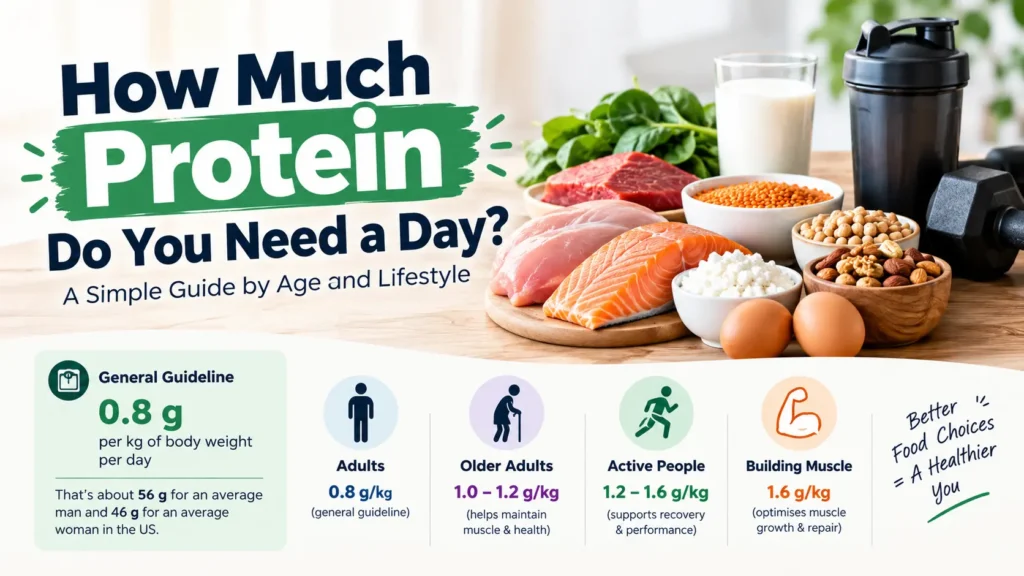
Most healthy adults need about 0.8 grams of protein per kilogram of body weight each day, which is roughly 56 grams for an average man and 46 grams for an average woman in the US. Older adults, active people and those building muscle often do better with 1.0 to 1.6 grams per kilogram.
That is the short version. The rest of this article explains what those numbers mean in real meals, and how to adjust them for your age, activity level and goals.
Why Protein Matters for Your Body
Protein is one of the three main nutrients in food, along with carbohydrates and fats. Your body uses it every day to build and repair tissue, make enzymes and hormones, support your immune system and keep your muscles, skin, hair and nails healthy.
Unlike fat, your body does not store protein in a handy reserve for later. That means you need a steady supply through food. Protein also helps you feel full after a meal, which is why many people find it easier to avoid constant snacking when each meal includes a good source.
What Protein Is Made Of
Protein is built from smaller units called amino acids. Your body can make some of them, but nine are called essential amino acids because you must get them from food. Animal foods such as eggs, fish, meat and dairy usually contain all nine. Many plant foods contain most of them, and eating a mix across the day covers your needs.
How Many Calories Does Protein Give You?
One gram of protein provides about 4 calories, the same as carbohydrates. Fat provides about 9 calories per gram. The Dietary Guidelines for Americans suggest that adults get roughly 10 to 35 percent of their daily calories from protein, which leaves plenty of room for different eating styles.
Daily Protein Intake by Age and Sex
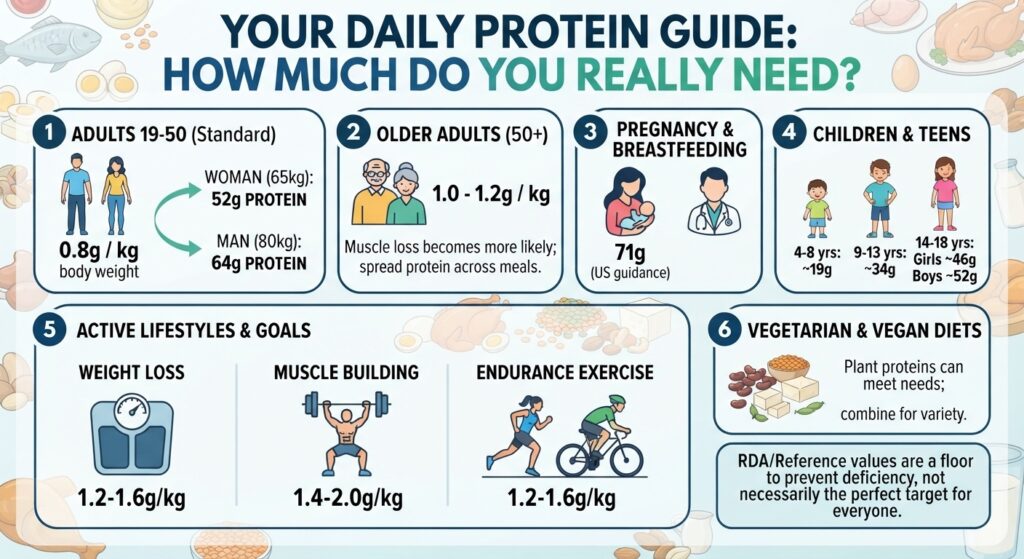
Health bodies in different countries use slightly different numbers, but they sit in the same range. In the United States, the Recommended Dietary Allowance for adults is 0.8 grams per kilogram of body weight. The UK uses a reference intake of 0.75 grams per kilogram. The European Food Safety Authority uses about 0.83 grams per kilogram. Australia and New Zealand set similar targets, with higher figures for people over 70.
These are the amounts needed to prevent deficiency in healthy people. They are a floor, not a perfect target for everyone.
Children and Teenagers
Growing bodies need protein for development. As a rough guide for the US, children aged 4 to 8 need about 19 grams a day, children aged 9 to 13 need about 34 grams, and teenagers aged 14 to 18 need about 46 grams for girls and 52 grams for boys. A varied diet with dairy, eggs, beans, fish or meat usually covers this without special effort.
Adults Aged 19 to 50
For a healthy adult with a light to moderate lifestyle, the standard figure of 0.8 grams per kilogram works as a starting point. A woman weighing 65 kilograms would need about 52 grams. A man weighing 80 kilograms would need about 64 grams.
Adults Over 50
As we age, our bodies become less efficient at using protein, and muscle loss becomes more likely. Many nutrition researchers suggest that healthy older adults aim for 1.0 to 1.2 grams per kilogram. Australia and New Zealand already set higher targets for people over 70. If you are over 50, spreading protein across all three meals is a smart habit.
Pregnancy and Breastfeeding
Needs rise during pregnancy and breastfeeding. US guidance suggests about 71 grams a day for most pregnant and breastfeeding women. Your doctor or midwife can give advice that fits your own situation.
How Much Protein Do You Need for Your Goals?
Your daily target changes depending on what you want from your body. Here are common situations and sensible ranges.
Weight Loss
When you eat fewer calories, you can lose muscle along with fat. Getting enough protein helps protect muscle and keeps you feeling full. Many dietitians suggest 1.2 to 1.6 grams per kilogram during a calorie deficit. Pair it with regular movement and slow, steady progress.
Building Muscle
People who lift weights or train regularly often aim for 1.4 to 2.0 grams per kilogram. Research reviews suggest benefits level off around the upper end of that range for most people, so more is not always better.
Endurance Exercise
Runners, cyclists and swimmers often benefit from 1.2 to 1.6 grams per kilogram to support repair after long sessions.
Vegetarian and Vegan Diets
Plant based eaters can meet their needs well. Because some plant proteins are slightly less easy to digest, a small increase can help, and variety matters. Combine beans, lentils, tofu, tempeh, whole grains, nuts and seeds through the day.
Sitting Most of the Day
If you are not very active, the standard 0.8 grams per kilogram is usually enough. You do not need protein shakes or bars to meet it.
How to Calculate Your Daily Protein Target
You only need a calculator and your weight. Here is the simple method.
- Find your weight in kilograms. If you use pounds, divide by 2.2.
- Choose a number from the ranges above that fits your life, such as 0.8, 1.2 or 1.6.
- Multiply your weight by that number.
Worked Examples
- Sam is 70 kilograms (154 pounds), works at a desk and walks daily. At 0.8 grams, Sam needs about 56 grams a day.
- Priya is 62 kilograms (137 pounds), is 58 years old and wants to protect her muscle. At 1.1 grams, she needs about 68 grams a day.
- Jordan is 85 kilograms (187 pounds) and lifts weights four times a week. At 1.6 grams, Jordan needs about 136 grams a day.
If you are carrying a lot of extra weight, some experts use a goal weight rather than current weight for the calculation. A registered dietitian can help you choose the best number.
Best High Protein Foods and How Much They Give You
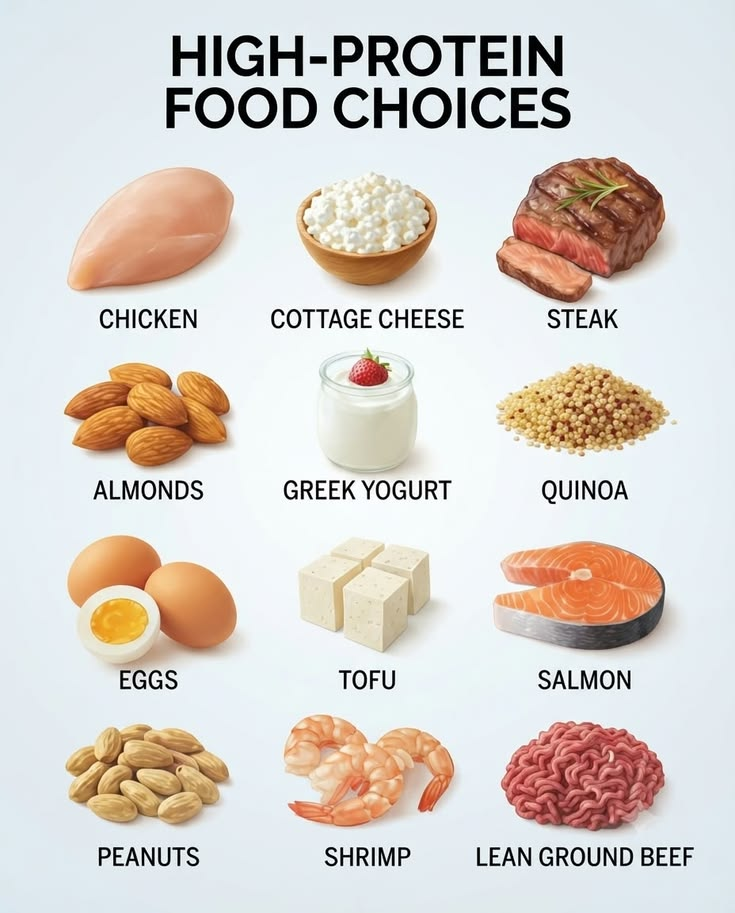
You do not need fancy products. Everyday foods make it easy. These are approximate amounts, and labels vary by brand.
Animal Sources
- Chicken breast, cooked, 100 grams: about 31 grams
- Canned tuna, drained, 100 grams: about 25 grams
- Salmon fillet, cooked, 100 grams: about 22 grams
- Lean beef mince, cooked, 100 grams: about 26 grams
- Greek yogurt, one small tub of 170 grams: about 17 grams
- Cottage cheese, half a cup: about 12 grams
- Egg, one large: about 6 grams
- Milk, one cup or 250 millilitres: about 8 grams
Eggs are a budget friendly choice, and our guide to what boiled egg water can be used for shows how to waste even less when you cook them.
Plant Sources
- Lentils, cooked, one cup: about 18 grams
- Chickpeas, cooked, one cup: about 14 grams
- Firm tofu, 100 grams: about 12 grams
- Tempeh, 100 grams: about 19 grams
- Peanut butter, two tablespoons: about 7 grams
- Almonds, a small handful of 28 grams: about 6 grams
- Cooked quinoa, one cup: about 8 grams
- Oats, half a cup dry: about 5 grams
Protein Powders and Bars
They can be handy when you are busy, but food should come first. Check labels for added sugar and look for products tested by a third party. They are optional, not essential.
What a Day of Eating Can Look Like
Here are three sample days to show how easy the numbers can be. They are examples, not strict plans.
Around 60 Grams a Day
- Breakfast: porridge with milk and a spoon of peanut butter, about 14 grams
- Lunch: lentil soup with bread and a side salad, about 18 grams
- Dinner: baked salmon with potatoes and vegetables, about 25 grams
- Snack: an apple and a few almonds, about 3 grams
Around 90 Grams a Day
- Breakfast: two eggs on toast with a glass of milk, about 24 grams
- Lunch: chicken and chickpea salad bowl, about 35 grams
- Dinner: stir fried tofu with rice and vegetables, about 22 grams
- Snack: Greek yogurt with berries, about 12 grams
Around 120 Grams a Day
- Breakfast: Greek yogurt bowl with oats, seeds and fruit, about 25 grams
- Lunch: tuna and bean wrap with salad, about 38 grams
- Dinner: lean beef and vegetable chilli with brown rice, about 40 grams
- Snacks: cottage cheese with crackers and a boiled egg, about 20 grams
If your day is busy, our Lifestyle section has more simple food and wellness ideas you can fit into a normal week.
Does Timing Matter?
Research suggests that spreading protein across the day works better for muscle health than eating most of it at dinner. Many people eat very little at breakfast and a large amount in the evening. Aiming for 20 to 30 grams at each main meal is a practical approach for most adults.
You do not have to drink a shake within 30 minutes of exercise. For most people, the total amount across the day matters far more than exact timing.
Can You Eat Too Much Protein?
For most healthy people, eating above the minimum is safe. The Dietary Guidelines range allows up to 35 percent of calories from protein. Problems are more likely when protein replaces fibre rich foods such as vegetables, fruit, beans and whole grains, or when someone has an existing health condition.
People with kidney disease, liver conditions or other medical issues are often told to limit protein. If you have a health condition, are pregnant, or take regular medication, speak to a doctor or registered dietitian before changing your diet.
Signs You May Not Be Getting Enough
- Feeling tired or weak more often than usual
- Slow recovery after exercise or injury
- Frequent hunger soon after meals
- Thinning hair or brittle nails
These signs can have many causes, so they are not proof of low protein. A health professional can help you find the real reason.
Common Protein Mistakes to Avoid
- Skipping breakfast protein and then overeating later
- Relying on processed bars and shakes instead of real food
- Ignoring fibre and vegetables while chasing a protein target
- Copying a gym influencer’s numbers without checking if they suit your body
- Cutting calories too low, which makes it harder to protect muscle
Simple Ways to Add More Protein Without Cooking More
- Add a boiled egg or Greek yogurt to your usual breakfast.
- Keep canned beans, lentils and tuna in the cupboard for fast meals.
- Swap a sugary snack for nuts, cheese or hummus with vegetables.
- Stir cottage cheese or silken tofu into sauces and smoothies.
- Choose a protein with every plate before you add sides.
Ginger is another ingredient many readers ask about, and you can see what it does in our article on what happens when you eat ginger every day for a month. It pairs well with chicken, tofu and fish.
If you travel often and need snacks you can carry, browse the Travel section for practical trip ideas, and pack hard boiled eggs, nuts or single serve yogurt pots.
Where to Find Trusted Guidance
For official advice, the Dietary Guidelines for Americans explain recommended eating patterns for US readers. UK readers can also see the NHS Eat Well pages for guidance on protein and balanced meals. Always speak to a qualified health professional before making big changes to your diet.
Frequently Asked Questions
How much protein should a woman eat a day?
An average adult woman in the US needs about 46 grams a day to meet the basic recommendation. Women who are active, over 50, pregnant or breastfeeding often need more. Using 0.8 to 1.2 grams per kilogram of body weight is a helpful range for most.
How much protein should a man eat a day?
The basic recommendation for an average adult man is about 56 grams a day. Men who lift weights or train often may aim for 1.4 to 2.0 grams per kilogram, depending on their goals and a professional’s advice.
Is 100 grams of protein a day too much?
For most healthy adults, 100 grams a day is safe. It may be a sensible target for a larger or very active person. It may be more than needed for a smaller, less active person. People with kidney disease should check with their doctor first.
What are the best protein foods for beginners?
Eggs, Greek yogurt, canned tuna, chicken, lentils, beans and tofu are easy, affordable and widely available. They work in quick meals and do not need special cooking skills.
Do I need protein shakes to hit my daily target?
No. Most people can reach their target with normal meals. Shakes can help when you are very busy or have higher needs, but they are optional.
Final Thoughts
The question of how much protein you need a day has a simple starting point: about 0.8 grams per kilogram for most healthy adults, and more if you are older, active or trying to build muscle. Start by checking what you already eat, add a protein food to each meal and adjust slowly. Small, steady habits work better than strict rules.
This article is for general information only and is not medical advice. Please speak to a qualified doctor or registered dietitian about your own needs.