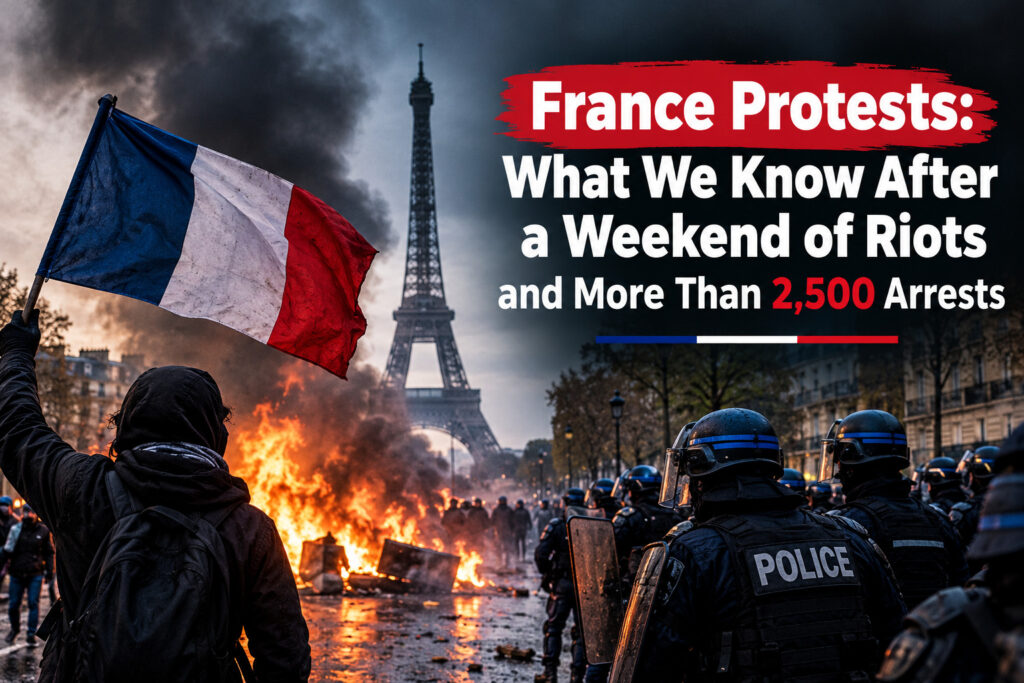
France is dealing with the aftermath of its worst urban unrest in years. The France protests began on Saturday, October 17, 2026, as hundreds of thousands of people marched against rising living costs and poor conditions in schools. By nightfall, violent groups had turned parts of Paris, Marseille, Lyon and Bordeaux into scenes of looting and clashes with police.
As of Monday, October 19, 2026, authorities say more than 2,500 people have been arrested, and the government is under pressure to explain how security forces were caught off guard. This report brings together what is known so far, based on reporting from France 24, Reuters, TIME and the Associated Press, written in our own words.
France Protests: The Quick Answer
France protests over living costs and school conditions drew hundreds of thousands of people on October 17, 2026, but riots and looting followed in cities including Paris and Marseille. More than 2,500 people were arrested and nearly 1,000 security personnel injured. President Macron admitted failures in preparation, rejected his interior minister’s resignation and promised those responsible would pay.
What Happened: A Timeline of the Weekend
The situation developed quickly over three days. Here is a simple timeline based on the reports available.
Saturday, October 17: Mass Protests and Violence
Demonstrations took place across the country in response to calls from a labour union, student groups and activists who hoped to revive the yellow vests movement. The Associated Press reported that authorities counted about 550,000 participants, while organisers said the figure was closer to 800,000.
Most marchers were peaceful, but violent groups broke away in several cities. Reports describe clashes with police, burning barricades and the looting of hundreds of businesses. France 24 reported that town halls were set on fire. Interior Minister Laurent Nuñez said 60,000 police and other security forces were deployed that day, but he admitted this was not enough to control the crowds in certain cities, according to Reuters.
Sunday, October 18: Address to the Nation
Tension continued on Sunday. Hundreds of people gathered again at the Place de la République in Paris, where police used tear gas as clashes flared on and off. France 24 reported that police made dozens of arrests there during the day.
The interior ministry said that nearly 2,400 people were arrested in the unrest, and almost 1,000 police, gendarmes and firefighters were injured, seven of them seriously. That evening, President Emmanuel Macron spoke to the nation on television.
Monday, October 19: Arrests Rise and Questions Grow
Police made about 350 more arrests on Sunday evening and overnight, according to a report published on Monday, which brought the total since the weekend to more than 2,500. French media reported fresh looting in Paris overnight. Interior Minister Nuñez was expected to visit Marseille, where widespread damage and looting were also reported.
On Monday, Macron’s office said he had turned down an offer of resignation from Nuñez. The focus has now moved from the streets to the government’s response.
Why Did People Protest?
The protests were called over two main concerns: the rising cost of living and poor conditions in schools. Many households in Europe have felt pressure from high prices for energy, food and housing, and the demonstrations tapped into that frustration.
Organisers included a labour union, student organisations and activist groups. Some hoped to recreate the energy of the yellow vests movement, which began in 2018 as a protest over fuel prices and grew into a wider campaign about living costs and fairness.
Mass protests in France are often marred by violence on the fringes of otherwise peaceful marches, as the Associated Press noted. This time, the scale of looting and damage went far beyond what many officials had expected.
The Numbers So Far
Figures have changed as reports came in, so it helps to see them together.
- Protest turnout: about 550,000 according to authorities and about 800,000 according to organisers.
- Police and security forces deployed on Saturday: 60,000.
- Arrests: about 1,800 in early reports, then nearly 2,400 by Sunday, and more than 2,500 by Monday.
- Injured police, gendarmes and firefighters: nearly 1,000, with seven seriously injured, according to the interior ministry.
- Damage: hundreds of businesses looted or damaged and several town halls burned.
Exact totals may change as authorities complete their counts, and different outlets may use slightly different numbers.
What Macron Said
In his Sunday address, Macron said that “nothing justifies” the violence, according to France 24. He said the country felt anger and shame, and he promised that people who looted would have to pay for the damage and that those who tried to attack the Republic would be held accountable.
He also said local authorities would be able to ban certain rallies if needed in the coming days and that officials would work with mayors to protect cities, public buildings and businesses. He asked Nuñez to draw lessons, especially on how intelligence was gathered and how the unrest was anticipated, and said he expected clear answers.
On Monday, Macron’s office said he rejected Nuñez’s offer to resign. TIME reported that the Élysée Palace cited the need for continuous command of the police. Macron instead told the interior ministry to find new ways to end the barricades and looting, and to be open about what he described as failures of intelligence and foresight.
The Interior Minister’s Admission
Nuñez, a former Paris police chief, acknowledged on Monday that police had lost control in some cities over the weekend, according to TIME. He had offered his resignation because he felt responsible for how events unfolded.
The admission is significant. Security forces are usually well prepared for large demonstrations in France, and the government now faces questions about why 60,000 personnel were not enough and why warning signs were missed.
Political Fallout
The unrest has quickly become a political test for the government.
Mayors Demand Answers
The mayors of France’s biggest cities demanded explanations on Monday for what they called a lack of preparation by security forces, according to Reuters. Local leaders are often the first to deal with damage to shops, transport and public buildings, so their voices carry weight.
Opposition Criticism
Opposition politician Le Pen criticised the government, describing it as lacking direction, according to Ynet. Other parties are also expected to use the debate to question the government’s handling of security and living costs.
Budget and Market Concerns
Reuters noted that tension inside Macron’s fragile government comes just as it needs to pass a budget bill to bring public finances under control. That timing could further unsettle investors, who already watch France’s finances closely. For wider coverage of the economy, see our Business section.
What It Means for Residents and Businesses
For shop owners and residents, the immediate impact is practical and personal. Hundreds of businesses were looted or damaged across several cities, and repairs and insurance claims will take time. Public buildings, including town halls, were damaged in some places.
For many families, the bigger question is whether the issues that drove people into the streets will be addressed. Rising prices and school conditions have not gone away, and organisers have not said that their campaign is over. Some experts expect the debate on living costs to continue even as security takes priority.
Travelling to France? What to Know
If you are planning a trip to France, check the latest official travel advice before you go. UK travellers can find updates on the UK government France travel advice page, and readers in other countries should check their own foreign office or state department.
In general, it is sensible to avoid large demonstrations, follow local news, confirm train and flight schedules, and speak to your hotel or tour provider if your plans might be affected. For ideas on travel planning, browse our Travel category.
What to Watch Next
Several developments could shape the coming days.
- Local protest bans. Macron said mayors and officials may restrict certain rallies if needed. Watch for announcements from city authorities.
- A review of the police response. The government has promised more openness about failures of intelligence and planning.
- Further demonstrations. The sources reviewed for this article did not confirm new national protest dates, but organisers may announce more.
- The budget debate. The political climate could affect how smoothly the government moves its budget bill through parliament.
- Final damage and arrest figures. Official totals may change as investigations continue.
For continuing coverage, follow our Latest News and World News pages.
Frequently Asked Questions About the France Protests
Why are people protesting in France?
The demonstrations were called over rising living costs and poor conditions in schools. A labour union, student groups and activists organised them, and some hoped to revive the yellow vests movement.
How many people have been arrested in France?
As of Monday, October 19, 2026, reports say more than 2,500 people have been arrested since the weekend. Earlier counts were lower, and totals may change as authorities update their figures.
What did Macron say about the riots?
In a televised address on Sunday, Macron said nothing justifies the violence, promised that looters would have to pay for damage and said local authorities could ban certain rallies if necessary. He also asked for answers about failures in intelligence and preparation.
Did the French interior minister resign?
No. Laurent Nuñez offered his resignation, but Macron’s office said on Monday that the president turned it down and told him to focus on ending the barricades and looting.
Is it safe to travel to France right now?
Most travel in France continues, but you should check official government travel advice, follow local news and avoid large demonstrations. Confirm transport and accommodation plans if you are travelling to affected cities.
Sources and Update Note
This report was written in our own words from coverage by France 24 (October 18, 2026), Reuters (October 19, 2026), TIME (October 19, 2026), the Associated Press via the Washington Times (October 18, 2026) and Ynet (October 19, 2026). You can read the original France 24 report on Macron’s address for more detail. This is a developing story and figures may change.