The Brazil election 2026 results are in, and they have already started a legal fight. President Luiz Inácio Lula da Silva won Sunday’s presidential runoff on October 25, beating Senator Flávio Bolsonaro by nearly 4.4 million votes with 100% of ballots counted. Lula took about 51.8% of valid votes, enough for a fourth, non-consecutive term at the head of Latin America’s largest economy.
Bolsonaro has not conceded. Within hours of the electoral court’s announcement, he told supporters in Brasília that his legal team would ask for the whole runoff to be annulled. His complaint centres on a last-minute court order that kept polling stations open for two extra hours.
Here is what we know on Monday, October 26, 2026, and what to watch next.
Who Won the Brazil Election 2026?
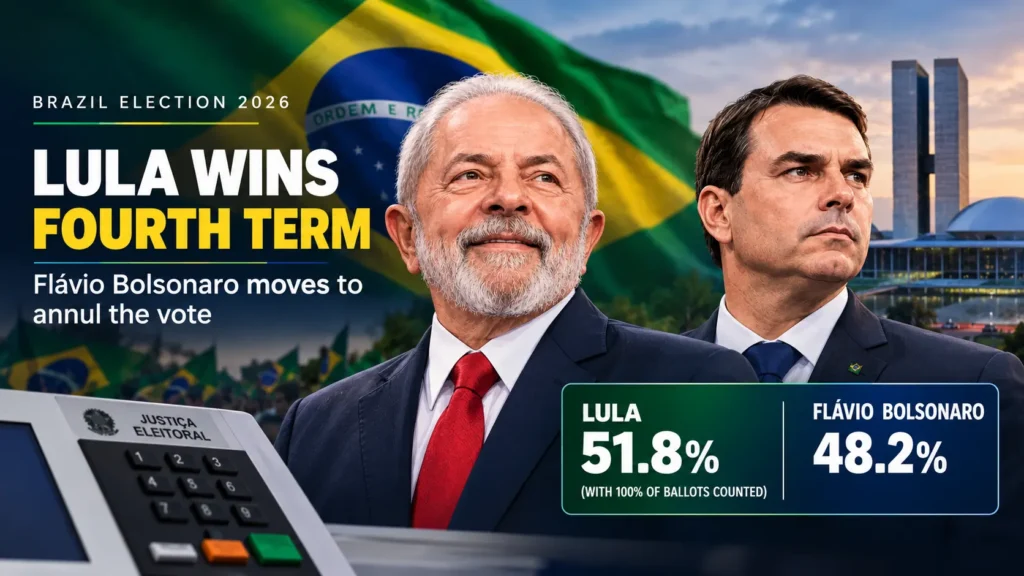
Quick answer: Luiz Inácio Lula da Silva won Brazil’s presidential runoff on October 25, 2026, with about 51.8% of valid votes against roughly 48% for Flávio Bolsonaro, a margin of close to 4.4 million votes. Lula’s new term starts on January 5, 2027, but Bolsonaro says he will ask the courts to annul the result.
Brazil Election 2026 Results at a Glance
| Detail | Result |
| Winner | Luiz Inácio Lula da Silva (Workers’ Party) |
| Runner-up | Flávio Bolsonaro (Liberal Party) |
| Runoff date | Sunday, October 25, 2026 |
| Lula’s share of valid votes | About 51.8% |
| Winning margin | Nearly 4.4 million votes |
| First round (October 4) | Bolsonaro 47.03%, Lula 45.16% |
| New term begins | January 5, 2027 |
| Status | Declared by the Superior Electoral Court (TSE); Bolsonaro seeking annulment |
How Lula Came Back From a First-Round Defeat
Three weeks ago, very few people would have bet on this outcome.
In the first round on October 4, Flávio Bolsonaro finished ahead with 47.03% of valid votes to Lula’s 45.16%, a gap of about 2.2 million votes. Neither man reached the 50% needed to win outright, which forced the runoff. Investors read the first-round result as a signal that power was about to change hands. Brazil’s Ibovespa stock index jumped about 8% the next trading day and pushed toward the record 200,000 mark.
Lula’s team responded by rebuilding the campaign. According to the Associated Press, he reached out to young voters, brought millions of supporters onto the streets in defence of democratic values and his record, and pushed several government programmes harder in the final weeks. He also leaned on a sovereignty message, arguing that a Bolsonaro presidency would hand Washington too much influence over Brazil at a time of heavy US tariffs.
It worked, by a margin wide enough to matter. Lula became the first candidate since Brazil’s military dictatorship ended in 1985 to finish second in the first round and still win the presidency.
The Two-Hour Voting Extension at the Centre of the Dispute
This is where the night got messy.
Minutes before polls were due to close on Sunday, Supreme Court Justice Cristiano Zanin ordered voting to be extended nationwide by two hours, to 7 pm Brasília time. Both campaigns had asked for more time, but for different reasons and on very different scales:
- Lula’s campaign cited problems with buses that take voters to the polls in São Paulo and Salvador, two cities that tend to back the president. In Salvador, Mayor Bruno Reis acknowledged that 75 public buses had been kept at a depot on election day.
- Bolsonaro’s campaign asked for a narrower extension covering a limited number of municipalities in southern states, where he is stronger, citing heavy rain, flooding and power cuts.
Zanin granted the broader request and later clarified that the extension applied only to polling stations where voting had not yet finished. On the ground, the order caused confusion. AP reporters in Brasília saw volunteers debate whether to stay after the announcement, with most leaving shortly after the original closing time. At one polling station in Rio de Janeiro, voting machines had already been switched off and could not be turned back on. The count was delayed by two hours, and it is still unclear how many polling stations actually stayed open late.
Why Flávio Bolsonaro says the vote should be annulled
Bolsonaro’s case rests on four points. First, he argues that a nationwide extension changed the rules of the election after the fact. Second, he says it treated voters in different states unequally. Third, he says Zanin, who does not sit on the electoral court, overrode the body that normally runs elections. Fourth, and politically the loudest, Zanin served as Lula’s personal defence lawyer before he joined the Supreme Court. Bolsonaro ally and congressman Nikolas Ferreira was among the first to point that out on election night.
Speaking to reporters, Bolsonaro said what happened on Sunday “was not normal” and called it unacceptable. His Liberal Party has said it will file a formal petition to annul the runoff.
What the electoral court and legal experts say
The other side of the argument is just as clear. TSE president Kassio Nunes Marques said the extension did not affect the result. Several legal experts quoted in international coverage have questioned whether Bolsonaro has enough grounds to overturn a vote decided by more than 4 million ballots. Some observers also note that the request reached Zanin through the court’s standard random assignment process, not by choice.
That leaves a political dispute and a legal one running side by side. The legal one looks like an uphill climb for Bolsonaro. The political one could last much longer.
What Happens Next: Courts, Certification and the Street
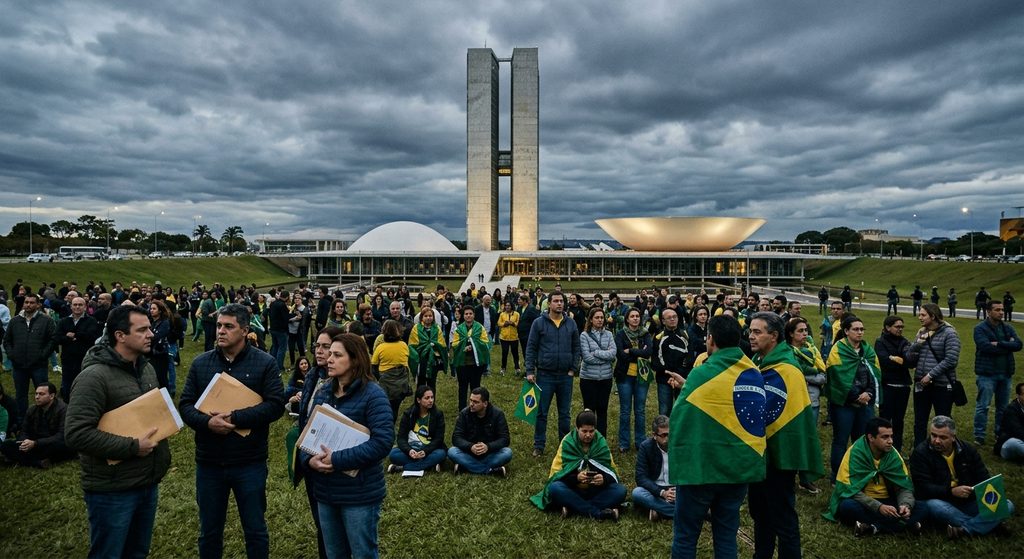
The next few days will decide whether this becomes a short legal footnote or a drawn-out crisis. Here is the sequence to watch:
- The petition. The Liberal Party’s lawyers are expected to file their annulment request with the electoral authorities this week.
- Certification. The TSE has already declared Lula the winner. Formal certification and the January 5 inauguration date stay in place unless a court rules otherwise.
- Protests. Analysts quoted by Seoul Economic Daily warned that large demonstrations are likely if Bolsonaro keeps contesting the result.
- Recognition. How quickly foreign governments and Brazil’s own Congress accept the result will shape how much pressure the challenge can build.
Brazilians have seen a version of this before. After Jair Bolsonaro, Flávio’s father, lost narrowly to Lula in 2022, his party asked the electoral authority to throw out votes from a large share of voting machines. The request was rejected, and on January 8, 2023, his supporters stormed government buildings in Brasília. Jair Bolsonaro was later convicted in 2025 over a plot to overturn that election. That history explains why markets and diplomats are watching this week so closely.
Why the Brazil Election Result Matters Beyond Brazil
A break in Latin America’s rightward trend
Lula’s win goes against a regional pattern. In recent years, a growing number of right-of-center candidates aligned with US President Donald Trump have won elections across Latin America. With Lula re-elected, Mexico and Brazil, the region’s two most populous countries, both have left-of-center leaders. Brazil’s economy, worth about $2.6 trillion a year, is now likely to keep its independent line with Washington despite the pressure of higher tariffs.
Markets did not like the surprise
Investors had priced in a Bolsonaro win after the first round, viewing him as more likely to keep a tight grip on public spending. CNBC reported that Brazilian assets traded abroad fell sharply before Monday’s open. ING analysts said markets will also track how quickly Bolsonaro accepts the result or lets the constitutional process run its course. Global risk appetite was already fragile this week, as our latest Bitcoin price today report shows, so a political standoff in a major emerging market adds one more source of nerves.
A tough Congress waiting for Lula
Even without the legal challenge, Lula’s fourth term will not be easy. Brazil recently elected a Congress that leans center-right and right, which means many of his plans will need deals with lawmakers who campaigned against him.
Who Is Lula? A Career That Keeps Coming Back
Lula, who turns 81 soon, began his political life as a union leader in the 1970s, organising strikes against the military government. He helped found the Workers’ Party and lost three presidential races before finally winning in 2002. He was re-elected in 2006 and handed over to his former minister Dilma Rousseff in 2010.
Then came the fall. Lula was jailed in 2018 on corruption convictions and spent 580 days in prison. Brazil’s Supreme Court later annulled the sentence after messages emerged suggesting the judge in his case had been biased. He beat Jair Bolsonaro in 2022 and has now beaten his son.
At 80, he joins Trump and Nicaragua’s Daniel Ortega among the oldest presidents in the Americas. Most observers expect this to be his final term.
Who Is Flávio Bolsonaro?
Flávio Bolsonaro is a senator for the Liberal Party and the eldest son of former president Jair Bolsonaro. He built his campaign around a tough-on-crime message and a promise to bring down food prices, two issues that hurt Lula badly in the polls. He led narrowly in several surveys before the runoff and won the first round outright on votes, which is why his supporters see Sunday’s result as a shock rather than a fair defeat. His challenge to the result will define his political future as much as the vote itself.
The Issues That Decided the Race
Strip away the court drama and the campaign came down to a few everyday worries:
- Cost of living. Food prices and household bills were the top concern for many voters, and Bolsonaro hit Lula hard on them.
- Public security. Crime was Bolsonaro’s strongest issue. Lula answered with spending on social programmes and incentives.
- Corruption. Both camps faced suspicions involving family members and allies, which blunted the issue for either side.
- Sovereignty and the US. Lula’s warnings about outside influence gave him a message that cut through in the final weeks.
What to Watch This Week
If you are following the Brazil election 2026 results story, keep an eye on the formal annulment filing, any statement from the TSE on its timeline, the size and tone of weekend protests, and Monday’s trading in the Brazilian real and Ibovespa. Each will tell you how seriously the country is taking the challenge.
For more world news this week, read our coverage of the France protests and more than 2,500 arrests, the Witkoff Putin talks on a Ukraine peace proposal, Kyiv’s claim that Russia ignored the energy ceasefire, and why the International Criminal Court won the Sakharov Prize 2026. You can find every update in our latest news section.
Frequently Asked Questions
Who won the Brazil presidential election 2026?
Luiz Inácio Lula da Silva won the runoff on October 25, 2026, beating Senator Flávio Bolsonaro by nearly 4.4 million votes. It is his fourth, non-consecutive term as president of Brazil.
What percentage of the vote did Lula get?
With 100% of the vote counted, Lula received about 51.8% of valid votes. Flávio Bolsonaro received roughly 48%.
Why does Flávio Bolsonaro want the election annulled?
He objects to a last-minute order by Supreme Court Justice Cristiano Zanin that extended voting nationwide by two hours. Bolsonaro says the order changed the rules, treated states unequally and was issued by Lula’s former lawyer.
Who is Cristiano Zanin?
Cristiano Zanin is a justice of Brazil’s Federal Supreme Court. Before joining the court, he was Lula’s personal defence lawyer, which is why the Bolsonaro campaign questions his ruling on election night.
Can the Brazil election result be overturned?
It is unlikely. The head of the electoral court said the voting extension did not affect the result, and legal experts doubt a 4.4 million vote margin can be reversed on these grounds. The courts will still have to rule on the petition.
When does Lula’s fourth term begin?
Lula’s new term begins on January 5, 2027.
How did markets react to Lula’s win?
Brazilian assets fell sharply in early trading on Monday because investors had expected a Bolsonaro victory after the first round. Analysts are watching how quickly the dispute over the result is settled.