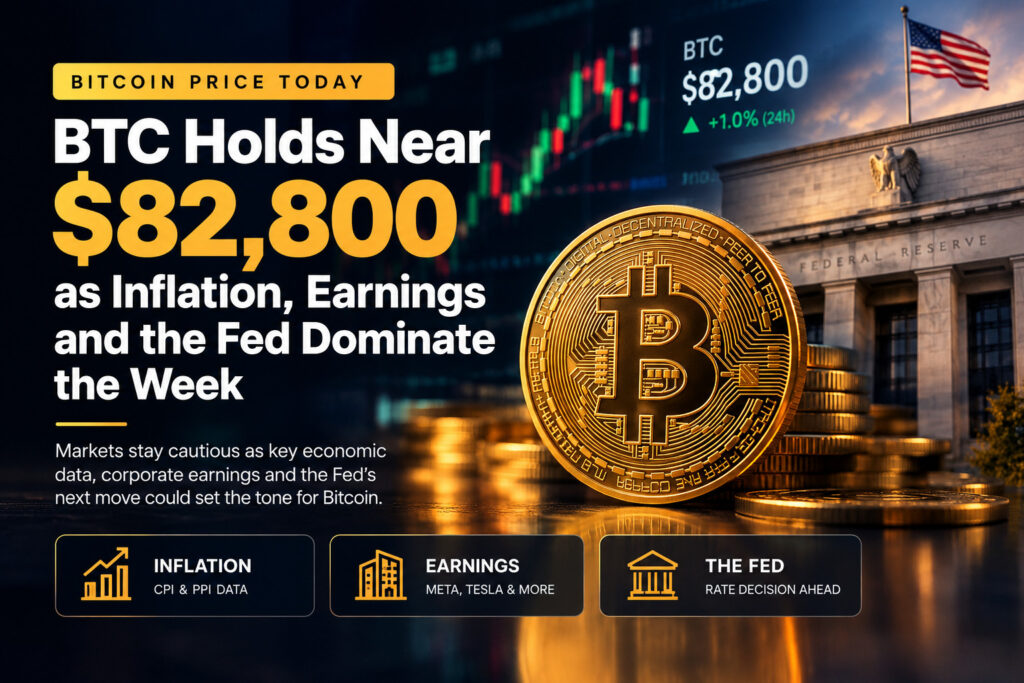
Bitcoin price today is hovering close to $82,800 on October 22, 2026, after a choppy week in which the world’s largest cryptocurrency briefly slipped below $80,000. Traders are now watching a packed calendar of earnings reports, US economic data and a Federal Reserve meeting that begins next week. This article explains what moved the market, what to watch over the next few days and why crypto prices are so closely tied to inflation and interest rates right now.
Quick answer: As of October 22, 2026, Bitcoin is trading near $82,800, up about one percent over 24 hours but slightly lower on the week. Hot US inflation data, a sell off in technology shares and heavy use of leverage pushed prices below $80,000 earlier. The Federal Reserve meets on October 27 and 28.
Bitcoin Price Today: Where the Market Stands on October 22, 2026
According to market data reported by crypto.news on October 19, Bitcoin traded at roughly $82,800 at press time. That was a gain of around one percent over 24 hours and a decline of about 1.1 percent over seven days. The reported weekly trading range ran from $79,806 to $84,231, which shows how wide the swings have been.
A daily market report published by KuCoin News on October 22 put Bitcoin at about $83,036, up 1.34 percent, and Ethereum at about $2,449, up 1.71 percent. The same report described Bitcoin as being in a consolidation phase, which is a term traders use when price moves sideways in a fairly narrow range after a bigger move. It also listed the Crypto Fear and Greed Index at 63, up from 55 the day before. That reading sits in the greed zone, which suggests sentiment has improved a little.
Another snapshot from the NordFX Market Pulse on October 22 showed Bitcoin near $82,830 and Ethereum near $2,446. It also pointed to Brent crude oil above $110 a barrel, a figure that matters because energy costs are feeding into inflation worries.
The wider market remains under pressure. A weekly rollup published by Caleb and Brown on October 20 put the total crypto market value at around $2.76 trillion, down about 2.1 percent over seven days. Every sector tracked in that report lost ground. Currency style coins held up best with a decline of about 1.9 percent, smart contract platforms fell around 4.8 percent and financial tokens lagged with a drop of about 10.1 percent.
If you want to keep up with daily market stories, you can find more in our Crypto News section.
What Pushed Bitcoin Below $80,000 Last Week
No single event explains the dip. Instead, several pressures arrived together, and each one made the others feel worse.
Hotter than expected inflation
Crypto.news reported that the US Consumer Price Index rose 0.6 percent in September compared with August, taking annual consumer inflation to 3.7 percent. Producer prices, which measure what businesses pay at the wholesale level, rose 1.3 percent in September and 6.3 percent from a year earlier, according to Bureau of Labor Statistics data cited in the report. Energy costs were a major driver, climbing 10.8 percent in the month.
When inflation runs hot, investors worry that central banks will keep interest rates higher for longer or even raise them again. After the producer price release, Bitcoin fell toward $81,500 as traders reconsidered the odds of further rate rises.
A rough week for technology stocks
The Nasdaq Composite lost about 4.5 percent in the previous week, and semiconductor shares fell even more, according to crypto.news. The selling followed questions about whether the huge spending on artificial intelligence infrastructure will pay off. Bitcoin does not always move with technology shares, but when investors cut risk in one area they often do the same in others, including crypto.
Leverage made moves bigger
A separate analysis cited by crypto.news on October 14 noted that $811 million in crypto positions had been liquidated during an earlier decline, while open interest remained high. Open interest is the total value of outstanding futures and options contracts. When many traders borrow money to bet on price moves, a sudden shift can force automatic selling, which pushes prices lower and triggers more selling. Analysts call this a leverage shakeout.
Five Events That Could Move Crypto This Week
Crypto.news highlighted five scheduled events for the week of October 19 to 23. None of them can tell us in advance where Bitcoin will go, but they help explain why traders are cautious.
Thursday, October 22: Meta and Tesla earnings
Meta Platforms and Tesla are due to report quarterly results. Investors want to see how heavy spending on data centres and artificial intelligence compares with revenue growth at Meta, and how vehicle sales, profit and spending on robotics and driving software look at Tesla. IBM reports the same day. At the time of writing, neither company had published its results, so the reaction is still unknown.
Thursday, October 22: Oil inventory data
The US Energy Information Administration publishes its weekly petroleum report. It covers crude oil stocks, refinery activity and fuel supplies. The report is not an inflation measure, but it can move oil prices, and oil prices feed into inflation expectations.
Thursday, October 22: UK inflation data
The weekly rollup from Caleb and Brown also listed UK inflation figures for the same day. UK and Canadian CPI releases were noted in the NordFX market summary as well. These matter because global investors watch inflation in all major economies, not only the United States.
Friday, October 23: US jobless claims
Weekly initial jobless claims show how many people filed for unemployment benefits in the previous week. A higher number can suggest the job market is cooling. A lower number can suggest employers are holding on to staff. A single week can be noisy, so analysts compare it with other labour data.
Friday, October 23: Business activity and consumer sentiment
S&P Global releases flash Purchasing Managers’ Index readings for manufacturing and services. A reading above 50 generally signals expansion, while a reading below 50 signals contraction. On the same day the University of Michigan publishes its final October consumer sentiment survey. The preliminary reading fell to 46.3 from 48.1 in September, and consumers expected inflation of 4.7 percent over the next year, according to crypto.news. These are opinions of households, not official inflation figures.
The Federal Reserve Meeting on October 27 and 28
The biggest scheduled event for markets is the Federal Reserve policy meeting. According to crypto.news, Fed officials entered their communications blackout on October 17, and it runs through October 29. During this period policymakers do not give public comments on policy, so investors rely on economic data and market pricing.
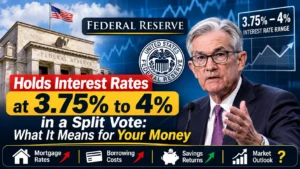
At the September meeting, the Fed raised its target range by a quarter of a percentage point to 3.75 percent to 4 percent, as reported by crypto.news. The mix of persistent inflation and a changing job market has made the next decision harder to predict. You can see the official schedule on the Federal Reserve meeting calendar.
It is worth remembering that nobody knows what the Fed will decide. Markets price in probabilities, and prices can move sharply if the decision or the tone of the statement differs from what traders expected.
How Interest Rates and Inflation Affect Bitcoin
Many newer readers wonder why a digital asset that runs on a global network reacts to US economic reports. There are a few reasons.
Higher rates make safer options more attractive
When interest rates rise, savings accounts, bonds and money market funds pay more. That can reduce the appeal of assets that pay no interest and swing in value, such as Bitcoin. When rates fall, the opposite can happen.
Borrowing costs affect risk taking
Crypto traders often use borrowed money. When borrowing becomes more expensive, there can be less leverage in the system, and less buying power overall.
Investors treat crypto as a risk asset in the short term
Some people describe Bitcoin as digital gold, but in daily trading it often moves with growth and technology shares. When stock markets fall, crypto frequently falls too. This link is not perfect and it can change over time.
Energy prices matter indirectly
With Brent crude above $110, higher fuel costs can push up the price of almost everything. That keeps inflation high and makes rate cuts less likely. For readers who follow the wider economy, our Business section covers related stories.
Ethereum and the Wider Crypto Market Today
Ethereum, the second largest cryptocurrency, was trading near $2,450 on October 22 in the KuCoin and NordFX reports, up about two percent on the day. XRP, BNB and Solana were also showing small daily gains on the crypto.news price ticker during the report’s publication.
Solana was in focus because its Alpenglow upgrade was scheduled for October 22 after an earlier delay, according to the Caleb and Brown rollup. Developer group Anza says the new consensus design cuts the time to final confirmation from about 12.8 seconds to about 150 milliseconds. Upgrades like this change how fast a network settles transactions, though they do not guarantee a change in price.
The KuCoin report also noted several token unlocks scheduled for October 20 and 22. A token unlock is when coins that were locked up are released to investors or teams. Large unlocks can add selling pressure, although the effect varies from project to project.
For more on devices, apps and the technology behind digital assets, explore our Technology category.
Regulation and Institutional Headlines to Know
Price is only part of the story. Several policy and business headlines appeared in crypto coverage this week.
- Europe named USDC its first significant electronic money token, a designation under the EU crypto rulebook known as MiCA, according to crypto.news coverage.
- Index provider MSCI finalised rules that could exclude certain companies that hold large crypto treasuries, including Strategy, as noted in the Caleb and Brown rollup.
- A White House crypto adviser stepped down, according to the same rollup.
- Ripple filed a comment letter supporting an SEC crypto rule while asking for key changes, as reported by crypto.news.
- Google updated its crypto advertising policy in the United Arab Emirates, with licensing and certification requirements effective October 22, according to the KuCoin report.
These stories show a market that is still being shaped by rules, indexes and policy decisions, as well as by price charts.
Key Terms Explained in Plain English
Consolidation
A period when price moves sideways instead of trending strongly up or down.
Resistance and support
Resistance is a price level where selling has often appeared in the past. Support is a level where buying has often appeared. Crypto.news reported that Bitcoin stalled below resistance near $84,200 after a rebound with US stocks.
Liquidation
When a leveraged position is closed automatically because the trader no longer has enough collateral to cover losses.
Open interest
The total value of outstanding futures and options contracts. High open interest means many positions are open, which can make price moves sharper.
Fear and Greed Index
A sentiment score from 0 to 100. Low numbers suggest fear and high numbers suggest greed. It is a snapshot of mood, not a prediction.
What Different Outcomes Could Mean
There is no reliable way to forecast crypto prices, but it can help to understand how traders think about the possibilities.
- If inflation and jobs data come in softer, some traders may expect less pressure on the Fed, which could improve sentiment for risk assets.
- If data stays hot, traders may expect rates to stay higher for longer, which has recently coincided with weaker crypto prices.
- If technology earnings reassure investors about artificial intelligence spending, stock markets could steady, and crypto may follow or may ignore the move.
- If technology earnings disappoint, a new round of risk reduction could affect many markets, including crypto.
Any of these paths can change quickly. Markets often react to surprises rather than to the news itself.
Risks Readers Should Understand
Crypto is volatile. A daily move of several percent is common, and large declines can happen without warning. Keep these points in mind.
- Prices can fall as quickly as they rise
- Leverage can magnify losses and lead to automatic closing of positions
- News headlines and social media can create fast and emotional reactions
- Scams are common, including fake giveaways, impersonation and fraudulent platforms
- Only the crypto asset itself is at risk in some cases, but exchanges and platforms can also fail or be hacked
- Tax rules differ by country, so check your local rules
Anyone thinking about crypto should do their own research, understand how much they could afford to lose and consider speaking to a qualified financial adviser in their country.
Frequently Asked Questions
What is Bitcoin price today?
On October 22, 2026, Bitcoin is trading near $82,800 to $83,000, according to several market reports. That is up about one to 1.3 percent over 24 hours but slightly lower over the past week. Prices change every second, so check a live data source before making any decision.
Why did Bitcoin fall below $80,000?
Crypto.news reported that hot US inflation data, a sell off in technology shares and high leverage in the market all played a part. Concerns that the Federal Reserve might raise rates further also weighed on risk assets.
When is the next Federal Reserve meeting?
The Federal Reserve meets on October 27 and 28, 2026. Officials are in a communications blackout period from October 17 to October 29, so they are not giving public views on policy during that time.
Does inflation affect crypto prices?
It can. Higher inflation can make investors expect higher interest rates, which often reduces appetite for volatile assets like Bitcoin. The relationship is not constant, and other factors such as regulation, adoption and market sentiment also matter.
Is Bitcoin a safe investment?
Bitcoin is a high risk asset with large price swings. Nobody can promise returns, and you can lose money. If you are unsure, speak to a qualified financial professional before investing.
Final Thoughts
Bitcoin price today reflects a market that is waiting. Traders are weighing inflation figures, technology earnings, energy prices and the Fed’s next move, all while leverage and sentiment keep prices jumpy. Whether Bitcoin breaks above recent resistance or tests the $80,000 area again, the next few days of data will matter. We will keep covering the story in our Latest News section and our Crypto News section.
Sources for this article: crypto.news (October 19, 2026), KuCoin News Crypto Daily Market Report (October 22, 2026), Caleb and Brown Weekly Rollup (October 20, 2026) and NordFX Market Pulse (October 22, 2026). The reporting has been rewritten in our own words. Figures were accurate at the time of writing and may have changed.
This article is for information only and is not financial advice.