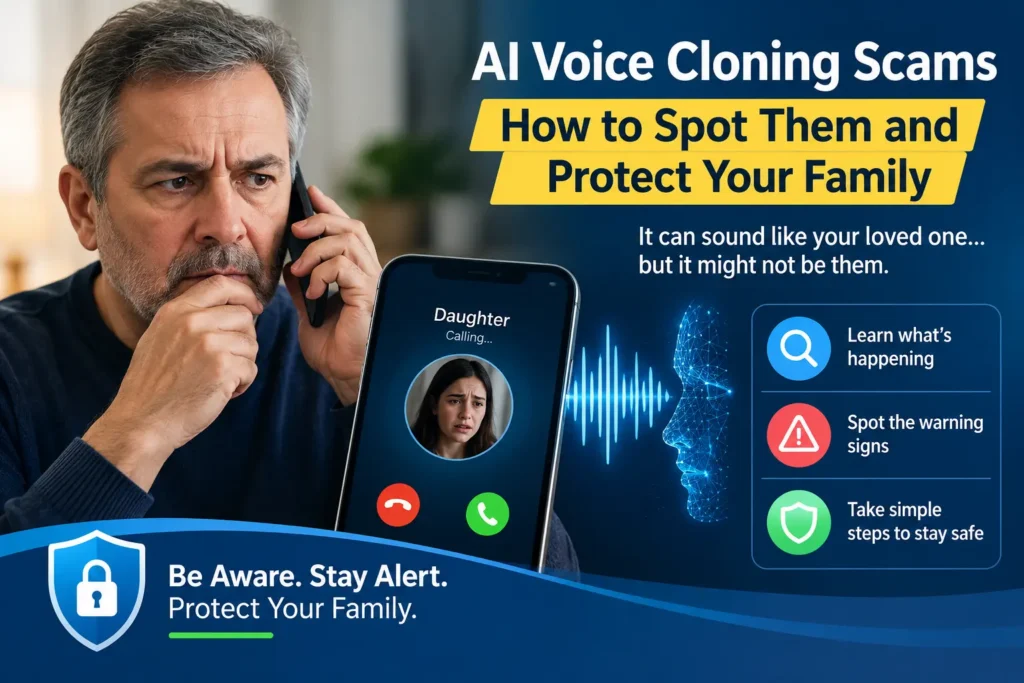
Imagine your phone rings. It is your daughter, and she sounds scared. She says she has had an accident and needs money right now. The voice is hers, the tone is hers, even the way she says your name is hers. But it is not her at all. This is how AI voice cloning scams work, and they are growing in the US, UK, Australia and Europe. The good news is that a few simple habits can protect you and your family. This guide explains what is happening, how to spot it and exactly what to do.
Quick Answer: What Are AI Voice Cloning Scams?
AI voice cloning scams use software to copy a real person’s voice from a short audio clip, then call you pretending to be a relative, boss or bank worker in an emergency. To stay safe, hang up, call the person back on a number you already know, and agree a private family code word.
What Is AI Voice Cloning?
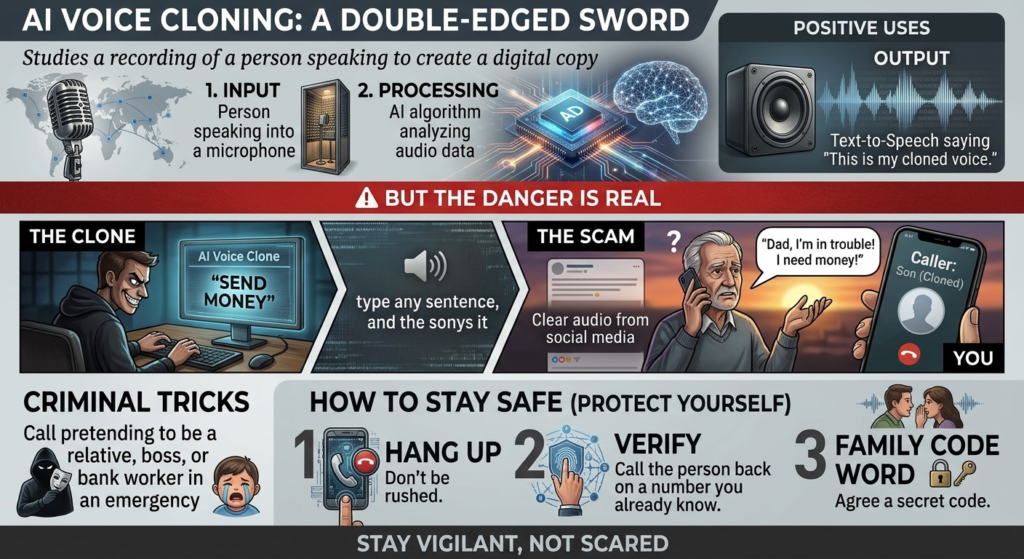
AI voice cloning is technology that studies a recording of a person speaking and then creates a digital copy of that voice. Once the copy exists, a person can type any sentence and the software will say it in the cloned voice. The same kind of tool is used for good reasons, such as helping people who have lost their speech, creating audiobooks and dubbing films.
The problem starts when criminals use the same tools to trick people. The tools are now cheap or free, easy to use and fast. Some security companies report that only a few seconds of clear audio can be enough to make a convincing copy, although quality varies by tool.
Voice Cloning and Deepfakes
A deepfake is a fake video, image or audio clip made with artificial intelligence. A cloned voice is a type of audio deepfake. Scammers sometimes combine a fake voice with a fake video, which makes the trick even harder to spot.
How Do Scammers Get Your Voice?
Scammers do not need to hack anything. Most of the audio they need is already public.
- Videos on social media, such as short clips, stories and live streams
- Podcasts, interviews and conference talks
- Voicemail greetings
- Video calls that are recorded without your knowledge
- Answering a call from an unknown number and saying yes or hello for a long time
They also gather personal facts such as names, jobs, holidays and family details from public profiles. These details make the call sound real.
How AI Voice Cloning Scams Usually Work
Most scams follow a pattern. Knowing it helps you stay calm.
- The scammer finds a target and some voice samples.
- They create a cloned voice using an online tool.
- They call or send a voice message, often from an unknown or spoofed number.
- They create urgency, such as an arrest, an accident or a deal about to be lost.
- They ask for money in a hard to trace way, such as gift cards, wire transfers, cash couriers or cryptocurrency.
- They tell you to keep it secret.
The goal is to make you panic so you do not stop and think.
Common Types of Voice Cloning Scams
The Family Emergency Scam
This is the most common type. A caller who sounds like a child, grandchild or partner says they are in trouble. They may claim to be in hospital, stuck abroad or in police custody. The US Federal Trade Commission warned about this kind of scam in 2023, noting that scammers can use cloned voices to make family emergency calls more believable.
The Fake Boss or Business Scam
A worker in a finance team gets a call or voice message that sounds like the manager. The voice asks for an urgent payment or for bank details to be changed. Businesses of every size can be targeted. In a widely reported 2024 case, an employee at a global engineering firm in Hong Kong was tricked into sending about 25 million US dollars after a video call with fake versions of senior colleagues.
The Bank or Official Impersonation
The caller sounds like a bank fraud officer, tax official or police officer. They say your account is under attack and you must move your money to a safe account. A real bank will never ask you to do this.
The Kidnapping Hoax
A caller plays a cloned voice crying in the background and demands a ransom. Often the person who is supposedly taken is safe at work or school. Always try to contact them directly before you do anything else.
The Romance or Friendship Scam
Scammers build trust over weeks and then use voice messages to seem more real. When they ask for money, the story is always urgent.
The Investment and Crypto Scam
A cloned voice of a famous person or a friend promotes a quick profit opportunity. Anyone who promises guaranteed returns is lying. If you follow crypto, our Crypto News section covers market updates and the risks that come with them.
Real Numbers and Warning From Authorities
Scams are rising across the world, and official bodies are paying attention.
- In the US, the FTC runs ReportFraud and has published consumer alerts about voice cloning and family emergency scams. It also ran a challenge in 2024 to encourage new tools that detect cloned voices.
- In the UK, Starling Bank launched a Safe Phrases campaign in 2024, citing a survey in which a large share of adults said they had been targeted by a voice scam. The National Cyber Security Centre also offers advice on spotting scam calls and messages.
- In Australia, the Australian Competition and Consumer Commission runs Scamwatch, which publishes warnings about phone and impersonation scams.
- In Europe, Europol has warned that criminals are using artificial intelligence to improve fraud and impersonation.
For current guidance, see the FTC Consumer Advice pages in the US or Scamwatch in Australia.
Warning Signs of a Cloned Voice Call
No single sign proves a fake, so look at the whole situation. Be careful if you notice any of these.
Signs in the Call Itself
- The voice sounds slightly flat, robotic or oddly paced
- There is a lot of background noise or crying that hides small flaws
- The caller avoids answering personal questions
- They repeat the same phrases or sound like they are reading a script
- The call quality is poor on purpose, which can hide errors
Signs in the Request
- A request for money right away
- Pressure to act without telling anyone
- A payment request using gift cards, crypto, wire transfer or cash pickup
- A story that does not fit what you know about the person
- A new phone number, with an excuse such as a lost phone
Remember that scammers can also fake caller ID, so a familiar name or number on the screen does not prove the caller is real.
What to Do If You Get a Suspicious Call
Here is a simple plan to follow. Keep it somewhere easy to find, such as the notes app on your phone.
- Stay calm and slow the conversation down. Say you will call back.
- Hang up the call.
- Contact the real person using a number you already have, not the number that called you.
- Ask a family member or friend to help if you cannot reach the person.
- Do not send money, codes or personal details until you have confirmed the story.
- Report the call to the authorities in your country.
Ask a Question Only the Real Person Would Know
Choose something that is not on social media. For example, ask what you had for dinner last Sunday or the name of a childhood pet. Avoid anything that appears on public profiles.
The Family Code Word: A Simple Free Defence
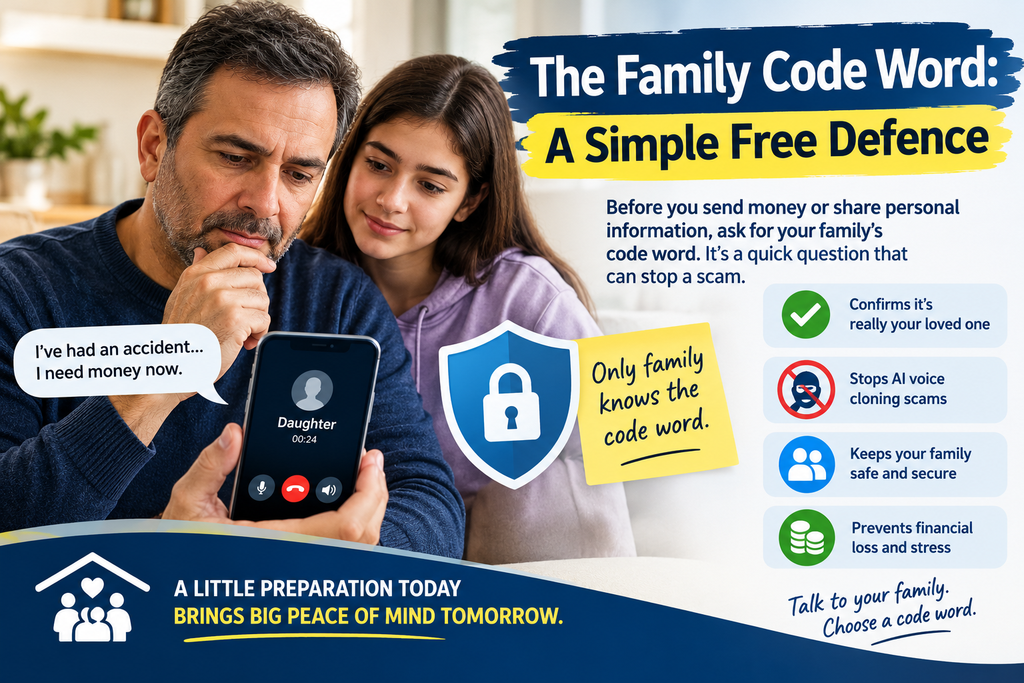
One of the best protections costs nothing. Agree on a private code word or phrase with your close family and friends. Use it only in emergencies and never post it online.
Tips for a good code word:
- Pick something unusual, such as a random pair of words
- Do not use a pet name, birthday or street name
- Share it in person or in a private conversation
- Make sure children and older relatives know it
- Change it if you think it was exposed
If someone calls in an emergency and cannot give the code word, treat the call as suspicious.
How to Reduce the Voice Samples Available Online
You cannot hide everything, but you can make it harder.
- Set social media accounts to private and review who can see your videos
- Remove old videos you no longer need
- Use a short, simple voicemail greeting, or the default one
- Be careful about posting long voice notes in public groups
- Do not answer unknown calls with a long conversation. Let them leave a message
- Check the privacy settings on apps that record or transcribe calls
At The Urban Magazine we also keep our own Privacy Policy clear, because privacy matters to every reader.
Protect Your Accounts Too
Scammers often combine a voice call with stolen account details. Strong digital habits make you harder to trick.
- Turn on two factor authentication for email, banking and social media
- Use a password manager and unique passwords
- Never share one time codes, even if the caller sounds like your bank
- Keep phone and app software up to date
- Secure your home network. Our guide to everyday items that block WiFi signals is a good start for understanding how your home connection works, and you can find more guides in our Technology section.
How to Protect Older Relatives
Older adults are often targeted because scammers expect them to react emotionally and to trust a call from a grandchild. You can help in a kind and respectful way.
- Talk about scams openly and without blame. Anyone can be fooled.
- Share the family code word and write it down in a safe place.
- Ask them to call you first before sending money to anyone.
- Set up call blocking tools offered by phone providers.
- Explain that real banks, police and tax offices do not demand gift cards or urgent transfers.
- Check in regularly so they feel comfortable telling you about strange calls.
Tips for Small Businesses and Remote Teams

Businesses can protect themselves with simple rules.
- Require two people to approve any payment above a set amount
- Confirm any change in bank details through a second, trusted channel
- Never approve a payment based only on a voice call or voice message
- Train staff to spot urgent requests from senior managers
- Keep a list of verified phone numbers for key people
- Make it safe for staff to say no or ask for proof
These rules cost little and can prevent large losses.
Can Detection Tools Spot a Fake Voice?
Some companies sell tools that try to detect AI generated audio, and researchers are working on better methods. But detection is not perfect, and scammers also keep improving. For now, the best defence is not relying on your ears. Use verification habits that work even if the voice sounds perfect, such as calling back and using a code word.
What to Do If You Have Already Paid
If you think you have been scammed, act quickly.
- Contact your bank or payment provider straight away and ask them to stop or recall the payment.
- Change passwords and secure your accounts if you shared any details.
- Report the scam to the right organisation, such as the FTC in the US, Action Fraud in the UK or Scamwatch in Australia. In Europe, contact your local police or national consumer authority.
- Keep records of calls, messages and receipts.
- Tell family and friends so they are not targeted next.
Do not feel ashamed. These scams are designed by professionals, and reporting helps protect others.
Common Mistakes to Avoid
- Trusting the caller ID on your screen
- Staying on the line to argue with the caller
- Paying first and checking later
- Keeping the call secret because the caller asked you to
- Sharing a verification code to prove who you are
- Assuming you are too smart to be fooled
A Quick Safety Checklist
- Agree a family code word this week
- Set social media profiles to private
- Turn on two factor authentication
- Save the numbers of close family and your bank in your phone
- Remember the rule: hang up, call back, verify
Frequently Asked Questions
How do AI voice cloning scams work?
Scammers copy a person’s voice from a short audio clip found online, then use it to call or message the victim. They invent an urgent problem and ask for money or private information. The cloned voice makes the story feel real so the victim does not stop to check.
How can I tell if a voice on the phone is fake?
It can be very difficult to tell by sound alone. Watch for urgent requests, pressure to keep secrets and unusual payment methods. Hang up and call the person back on a number you already know. Ask a question only they could answer, or use a family code word.
How much audio do scammers need to clone a voice?
It depends on the tool, but some security companies say a few seconds of clear audio can be enough for a basic copy. More audio usually gives a better result. That is why public videos and voice notes can be risky.
What should I do if a scammer calls me?
Hang up, do not share any personal details and do not send money. Contact the real person directly using a trusted number. Then report the call to your national fraud body, such as the FTC in the US, Action Fraud in the UK or Scamwatch in Australia.
Is voice cloning illegal?
The technology itself is legal in many places and has good uses. Using it to deceive people or steal money is illegal as fraud or impersonation in the US, UK, Australia and across Europe. Laws are changing quickly as governments respond to new risks.
Final Thoughts
AI voice cloning scams are scary because they use the voices of the people we love. But the defence is simple and powerful. Slow down, hang up, call back on a trusted number and use a private code word. Share these tips with your family tonight, especially older relatives and teenagers. A five minute chat today can stop a very painful call tomorrow.